Event 1
Murder of Eldon Mate
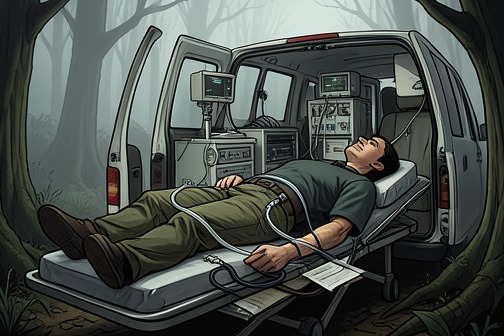
The [Murder of Eldon Mate](entity:event-recall-event-murder-of-eldon-mate-f9d9087cf9b2) is a killing staged to resemble the kind of assisted death Mate had arranged for others, then made unmistakably brutal by the injuries and message left on his body. The contradiction between the apparent medical procedure and the violence of the crime drives the investigation: the van’s equipment points toward a familiar ending, while the wounds show that someone has turned Mate’s own method into a performance of humiliation and control.
## Death in the Van
Mate was murdered in the very early hours of a fog-laden Monday in [September](entity:time-recall-time-september-8265260d4b2e). His death took place inside the van he used for assisted deaths, amid equipment that could make the scene appear to follow his established procedure. When [Milo Sturgis](entity:character-recall-character-milo-sturgis-2f67268d5cc2) explains the forensic findings to [Alex Delaware](entity:character-recall-character-alex-delaware-5f082af49613), he describes an intravenous line in each of Mate’s arms: one bottle contained thiopental, the tranquilizer Mate used, and the other potassium chloride, intended to bring on cardiac arrest. Mate’s thumb touched a small trip-wire device that would start the flow. At first glance, the arrangement could be read as a final use of his own system.
The coroner’s findings overturn that reading. Potassium chloride had begun to take effect, but the apparatus was only for show; Mate had already been attacked. A blow to the head cracked his skull and caused a subdural hematoma. The indentation was columnar, suggesting a length of pipe or a similar object, although the wound itself was not immediately fatal. The rear of the van was soaked with blood, and its spatter showed arterial spurts. Mate’s heart was still pumping as the killer inflicted further injuries. The scene therefore did not document a peaceful, voluntary death: it used the appearance of Mate’s work to disguise a homicide.
The violence was deliberate as well as lethal. Mate had been cut repeatedly, with eight deep wounds across his abdomen, groin, and thighs. Their square shapes made them seem almost arranged as a design. The injuries, including the extensive genital mutilation, transformed the van from a setting for assisted death into the site of a degrading spectacle. The distinction matters: the staged medication suggested control over the timing of death, while the wounds revealed a killer who had imposed a different, violent meaning on Mate’s body.
## A Message on the Body
Mate lay on his back, with his head near the front seat, on the mattress he provided for people who came to die. That familiar setting sharpened the crime’s reversal: the killer had taken over the space and equipment Mate had prepared for others. [Alex](entity:character-recall-character-alex-ad819204cb8d) recognizes the arrangement as an act of appropriation and a display of power, not merely a convenient location.
The killer made that display explicit. A sheet of plain white paper, eight by eleven inches, was fastened to Mate’s chest with a stainless-steel brad driven into his sternum. The computer-typed message read, “[Happy Traveling](entity:expression-recall-expression-happy-traveling-10b008dc1dc3), You Sick Bastard.” Its wording twisted Mate’s euphemism for death into an insult directed at him. The note also joined the staging to the mutilation: the medical setup imitated Mate’s work, while the message claimed the language of that work in order to mock and condemn him. The body was not only left behind; it was made to carry a message.
## Public Meaning and a Difficult Investigation
News of the van’s contents divided the public according to what they had already believed about Mate. Some had regarded him as an angel of death; others saw him as mercy personified and grieved his loss. The competing reactions persisted because the killing did not settle the moral dispute surrounding his practice. Instead, the crime placed that dispute beside an unmistakable fact: someone had murdered him, and the apparent assisted-death arrangement was counterfeit.
The murder received intense but brief attention. With no larger catastrophe dominating the news that day, it led the evening broadcast; Tuesday’s newspaper headlines followed, and Wednesday papers recapped the story after television had dropped it within a day. The coverage lasted four days, a measure of how quickly public attention in [Los Angeles](entity:location-recall-location-los-angeles-11eff639bdf5) moved on. For investigators, however, the case offered no comparable quick resolution. [Milo](entity:character-recall-character-milo-885f1c74a004) had worked long enough to expect no easy solve and no immediate break. The medical appearance of the scene complicated the central question rather than answering it, and the investigation had to distinguish a genuine death procedure from a criminal imitation.
## The Discovery Reconsidered
The first reading of the crime scene was not the last. Later, Alex understands that Paul Ulrich’s role in discovering Mate echoed another staged discovery associated with [Michael Burke](entity:character-recall-character-michael-burke-eb7b545161f5). The apparent helpfulness of a person arriving at a crime scene could provide a legitimate reason to be there; in retrospect, the discovery itself could belong to the performance. This changes the meaning of Ulrich’s presence from that of a witness who happened upon a horror to that of a man who had arranged an encounter with the aftermath of his own handiwork.
The circumstances of Ulrich and [Tanya Stratton](entity:character-recall-character-tanya-stratton-53a09fd04bc6)’s walk reinforce that reinterpretation. Stratton said they rarely went up to [Mulholland](entity:location-recall-location-mulholland-3be5cc17a918) except on Sundays, and she resented the changed routine and Ulrich’s insistence on it. He also wanted to speak to Milo at the site rather than at home. Ulrich presented the meeting as a kind of therapy for Tanya, but Alex later sees other purposes: keeping Milo away from Ulrich’s home and giving Ulrich another chance to revisit the scene. The contrast between the two walkers is telling. Stratton was visibly upset and wanted to leave; Ulrich came across as amiable, helpful, and unusually relaxed after encountering a bloodbath.
Ulrich’s self-presentation also acquires a darker edge in retrospect. He chatted about staying fit and the beauty of the location, a manner that fitted Michael Burke’s cultivated outdoorsman identity. His ease at the site, the engineered change in routine, and the repeated pattern of a killer appearing to discover his own work converge into a portrait of murder as performance. Mate’s death was designed to confuse investigators with a false medical explanation, to humiliate the victim through his own setting and language, and to give the killer a privileged place beside the spectacle he had created.
Event 2
Joanne Doss’s death
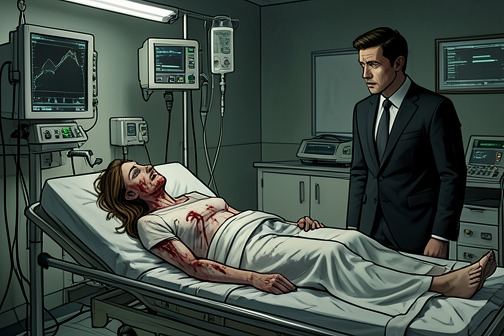
[Joanne Doss’s death](entity:event-recall-event-joanne-doss-f2bd56f024fc), disclosed in a conversation about how to support her daughter [Stacy Doss](entity:character-recall-character-stacy-doss-952f6955a9e3), followed a long and unexplained physical decline. She died by suicide at forty-three after choosing [Eldon Mate](entity:character-recall-character-eldon-mate-fa61505a7baf)’s help without telling her husband, [Richard Doss](entity:character-recall-character-richard-doss-7dbc6ac5b105). The account presents her death both as a private decision and as a rupture whose consequences continued through her family and her friends.
## Illness and Background
Joanne’s illness involved severe deterioration over a prolonged period, but no diagnosis was ever established. Several doctors examined her. One, [Bob](entity:character-recall-character-bob-71f5b16e99fd), evaluated her as a favor to Richard Doss, though he was not her regular internist; he found no explanation and referred her to an immunologist, after which she was passed on to another specialist. The succession of consultations produced no clear cause. Her death is identified as suicide, not as the outcome of a diagnosed disease, leaving the nature of the illness unresolved in the account.
Joanne was forty-three. Her friend, who had known her since their first children were babies, describes a shared history built through parenting: they attended Mommy and Me and preschool together, and had children in two successive age groups. Their children included [Eric Doss and Stacy Doss](entity:relation-recall-relation-eric-doss-and-stacy-2a8320199255), as well as the friend’s Allison and [Becky](entity:character-recall-character-becky-b2d09bb6c315). This history makes the report of Joanne’s death more than a clinical or police matter; it comes from someone whose family life had been intertwined with hers over many years.
## Joanne’s Decision and [Richard](entity:character-recall-character-richard-cc7ee1eeaeeb)’s Exclusion
The decision to go to Eldon Mate was Joanne’s, according to her friend, and not Richard’s. Joanne did not tell her husband. Instead, she disappeared one night and was found the following morning in [Lancaster, where Joanne met Mate](entity:location-recall-location-efe5aa773369). Richard learned what had happened when the police called him. The account does not establish what Joanne told Mate, what she expected from the encounter, or how she understood her own illness; it does establish that she acted without informing Richard and that the family learned of her choice after the fact.
Her friend describes Joanne as one of Mate’s Travelers, while hesitating over whether that term made Joanne a patient. That uncertainty marks a gap in the available explanation: the circumstances place Joanne in Mate’s orbit, but the conversation does not define their arrangement in medical terms. Richard tried to contact Mate afterward, but Mate did not return his calls. Joanne’s decision therefore had an immediate relational consequence as well as a personal one: Richard was left outside the choice and unable to obtain an explanation from the person Joanne had approached.
## Discovery and Family Aftermath
The information reached Richard through the police rather than through Joanne or Mate. Her friend suggests that being left out may help explain Richard’s hatred of Mate, but presents this as a possibility, not a confirmed account of Richard’s motives. The silence after Joanne’s disappearance and the unanswered calls make that interpretation plausible within the conversation, while leaving the full history between the men unknown.
Joanne’s children were left to live with the loss. Her friend considered [Stacy](entity:character-recall-character-stacy-8e3c8bf1f57b) somewhat depressed and thought a few sessions of grief counseling might help, though she did not expect that Stacy would necessarily need long-term therapy. Stacy had once been close to Becky, and the two girls used to spend time together; the families’ longstanding friendship thus extended into the children’s lives. The account’s concern is practical as well as retrospective: Joanne’s friend asks [Alex Delaware](entity:character-recall-character-alex-delaware-5f082af49613) to help Stacy, drawing on his experience with bereavement.
## Retelling and Continuing Consequences
Joanne’s death reaches the reader through a conversation held three months later, not through a direct scene of her final night. Its account is consequently limited to what her friend knows: the undiagnosed decline, Joanne’s independent decision, the disappearance, the police call, and Richard’s failed attempts to reach Mate. The friend openly marks the limits of her knowledge, and the cause of Joanne’s illness remains unanswered. That restraint distinguishes established events from conjecture about the motives behind them.
Later, Richard tells Alex Delaware that Joanne has not been a topic of conversation with Stacy since she stopped seeing him. He has noticed no unusual reaction in Stacy to Eldon Mate’s death, and says she has never been interested in Mate. This later report does not erase the bereavement; it shows instead how little the family has spoken about Joanne and how the effects of her death are encountered indirectly. Richard’s account that Mate murdered two other women after Joanne also places her death within a larger sequence, but does not resolve the unanswered questions surrounding her illness or the private decision that preceded it.
Event 3
Eldon Mett Murder
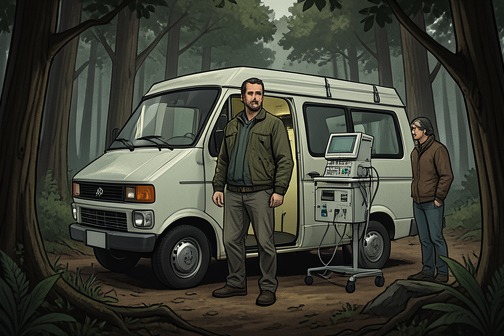
[Eldon Mate](entity:character-recall-character-eldon-mate-fa61505a7baf)’s murder is the crime around which the investigation keeps changing shape. A van in a wooded area on [Mulholland](entity:location-recall-location-mulholland-3be5cc17a918) suggests a private meeting, but the scene also resembles the work of a killer with a recognizable pattern. As investigators move between family grievance, forensic interpretation, and an unsettling painting, the murder appears not only as a death to explain but as an act whose staging may itself be meant to communicate.
## The meeting and the family hypothesis
One early reconstruction imagines Donny returning to confront the father who had abandoned and rejected him. [Milo Sturgis](entity:character-recall-character-milo-sturgis-2f67268d5cc2) considers whether Donny, despite a possible mental breakdown, might have retained enough intelligence to plan an attack. Mate’s growing public prominence could have sharpened an old grievance, and the idea of taking over the family business gives the imagined return an Oedipal cast. These are possibilities, not established facts: the proposed conversation in Mulholland, and the suggestion that Mate agreed to meet because of guilt or a taste for danger, belong to [Milo](entity:character-recall-character-milo-885f1c74a004)’s attempt to make motive and setting fit together.
The investigation gives that theory a concrete but ambiguous point of support. A search under [Eldon H. Mate](entity:character-recall-character-eldon-h-mate-5513370d06a0) produces no result, while a search under Eldon Salcido returns three California convictions whose identifying details fit. The record includes driving under the influence, larceny, and assault; Donny had served time in [Marin County](entity:location-recall-location-marin-county-c47dad6026f0) and was released six months earlier. The convictions establish a history of trouble and a recent return to freedom, but they do not prove that he killed Mate. Their force in the case lies in how readily they appear to complete a story of rejection turning into violence.
## The van and competing readings
The van becomes the investigation’s most important physical setting and an interpretive problem. [Leimert Fusco](entity:character-recall-character-leimert-fusco-045bf15c9dae) reasons that Mate may have been rendered semiconscious or unconscious, perhaps by a blow from behind or a choke hold. He notes that reports placed Mate in the van, unlike the tree-propping signature associated with [Michael Burke](entity:character-recall-character-michael-burke-eb7b545161f5). Yet the wooded site fits Burke’s previous killings, and its greater publicness could indicate increasing confidence. Mate’s public profile might also have made him attractive to a killer who could approach him by pretending to be interested in his work.
These are Fusco’s deductions, not a settled account of the murder. His proposed appeal to Mate’s ego offers one possible explanation for how a meeting could have been arranged; his comparison with Burke’s earlier crimes offers another way to read the location. The competing theories pull the same details in different directions. A meeting in the van can suggest a family confrontation arranged away from Mate’s apartment, or a killer’s calculated approach; the woods can mark a departure from Burke’s earlier methods while still resembling them. The uncertainty is central to the investigation, not a gap that the available evidence resolves.
## A portrait turns the killing into a message
The murder acquires a second, public scene when an unsigned oil painting appears at the rear door of Primal Images, an art gallery on Colorado Avenue in [Santa Monica](entity:location-recall-location-santa-monica-ce3bc4267c60). Wrapped in brown paper, the painting is described as a copy of Rembrandt’s [The Anatomy Lesson](entity:expression-recall-expression-the-anatomy-lesson-4734dcb94af7), altered to show Mate in two roles at once: dissector and cadaver. The gallery owner, Grant Kugler, finds it while arriving to unpack an installation. Its unexplained delivery makes the picture’s presence part of the case, not merely an image of the crime.
A newspaper report draws attention to similarities between the painting and details of the crime scene, and the picture is taken into police custody. The painting does not identify its artist or explain why it was left at the gallery. Instead, its doubled image makes Mate both the person who acts upon a body and the body acted upon. That reversal echoes the investigation’s larger difficulty: the victim’s public identity as a doctor associated with death complicates the effort to understand his own death, while the anonymous artist makes the killing seem deliberately staged for an audience.
## The case remains open to revision
The murder’s meaning shifts as each new detail invites a different account. Mate’s estranged son supplies a possible motive rooted in abandonment; the van and woods invite comparison with Burke’s killings; the painting makes the crime appear to have an authorial, performative dimension. None of those readings, on the evidence presented here, amounts to a final identification of the killer. Their accumulation instead shows why a single confident explanation is dangerous: motive, method, location, and message do not yet converge.
That instability gives the murder its narrative force. The investigation moves from a family’s private history to a public crime scene and then to a gallery, where the image of Mate’s death becomes an object to be inspected and held by police. Each setting changes what the killing seems to say without settling who made it happen. The case is therefore defined both by the death itself and by the unresolved struggle to distinguish a genuine clue from a persuasive story built around one.
Event 4
Joanne Doss's Assisted Death
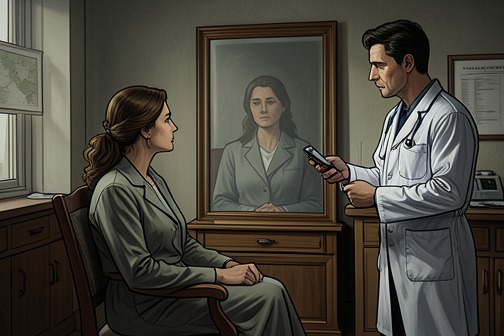
[Joanne Doss](entity:character-recall-character-joanne-doss-c7eeadd2109e)’s assisted death with [Eldon Mate](entity:character-recall-character-eldon-mate-fa61505a7baf) is reconstructed through her daughter [Stacy](entity:character-recall-character-stacy-8e3c8bf1f57b)’s later conversations with [Alex Delaware](entity:character-recall-character-alex-delaware-5f082af49613), not shown as a scene. Its decisive significance lies in Stacy’s refusal to make Mate the author of her mother’s death: she sees him as the means Joanne used to carry out a choice already formed, and the event as the final expression of Joanne’s withdrawal from her family. That interpretation separates Stacy from [Richard](entity:character-recall-character-richard-cc7ee1eeaeeb) and [Eric](entity:character-recall-character-eric-7ec3f96e28e6), who respond by blaming Mate, and leaves her wrestling with the harder possibility that her mother chose to leave.
## Causes and Background
Stacy’s account places Joanne’s decision within a longer history of emotional distance. Looking back, Stacy cannot recall whether she and her mother had enjoyed closeness when Stacy was young and Joanne was healthy. She does not deny that Joanne performed the acts expected of a good mother, but says she could not quite reach her: Joanne seemed to her made of air, impossible to hold onto. The illness did not create the entire separation; in Stacy’s view, the family’s disconnection preceded it.
That history shapes what Stacy means when she describes her mother as having erased herself. By the time Mate entered the picture, she believes, Joanne had already withdrawn from wanting to be alive. Stacy characterizes the assisted death as the ultimate passivity, not because she thinks Mate’s involvement was irrelevant, but because she sees the decision as Joanne’s and considers his role secondary to it. Her account therefore shifts the question from what Mate did to what Joanne had already stopped trying to do.
## The Last Morning and the News
Stacy recalls no warning that Joanne was about to die. On the morning in question, Joanne called her in to say hello before Stacy went to school and told her she looked pretty. Joanne had said such things before; nothing in the exchange struck Stacy as different. She remembers her mother looking as she always did. There was no goodbye, and Stacy did not understand the ordinary-seeming moment as a farewell.
Stacy learned what had happened through the news. Her first response was shock. After that shock passed, however, she found the event consistent with her understanding of Joanne’s state of mind. The gap between the routine morning kindness and the news of her mother’s assisted death gives the memory its particular force: what looked unremarkable to Stacy at the time became, in retrospect, the last contact before a departure she had not been told to expect.
## Blame and Competing Interpretations
Richard and Eric direct their anger at Mate, making him the family’s focus when confronted with a death they cannot control. Stacy describes that response as a tendency to attack what cannot be controlled, a posture she associates with a masculine urge to crush whatever causes distress. When [Alex](entity:character-recall-character-alex-ad819204cb8d) asks whether her father wants to crush Mate, she clarifies that this is rhetorical: Richard uses similar violent boasts about people who anger him, including someone trying to cheat him in a business deal. Stacy treats the language as a familiar habit, not as evidence that he literally intends to kill Mate.
Her own judgment of Mate is contemptuous, but it does not make him the central cause. She calls him pathetic and a loser, then insists that Joanne would have stopped being even without him. Later, when Alex asks directly what she thinks of Mate, Stacy again refuses to treat him as the decisive force in her mother’s death. In her view, the public story gives him too much agency: he did not create Joanne’s wish to disappear, and there was nothing left for him to do once she had already given up on being.
## Family Silence and the Aftermath
The conversations also bring into focus a household in which people lived together without truly connecting. Stacy admits that in earlier sessions she had not been honest about how troubled the family was. She remembers little of her early relationship with Joanne and cannot resolve what her mother did. Richard and Eric’s shared accusation against Mate, she argues, lets them avoid the truth that the choice was Joanne’s. Alex answers that, ultimately, it was; Stacy then describes Mate as the vehicle Joanne could have replaced with anyone else. She understands the death as a decision to leave her family without saying goodbye.
This conclusion does not give Stacy emotional closure. The loss remains bound up with unanswered questions about whether Joanne cared enough to keep trying and why she never told her daughter what she intended. In one session Stacy’s grief appears in her posture: she crosses her arms over her chest and draws her shoulders forward as if bound by a straitjacket. At another point, after saying that nothing more remains to be said about her mother, she announces that she must attend to her own future and has finally decided she might want one. The shift does not undo the death or settle its meaning; it marks a tentative turn from interpreting Joanne’s disappearance toward imagining a life of her own.
## Narrative Significance
Because the event reaches the reader through Stacy’s recollection, its meaning remains inseparable from what she could observe and what she later inferred. The book gives concrete detail about the last morning and the family’s competing responses, but no account here of the assisted death itself. Instead, the ordinary compliment, the absent farewell, and the later argument over responsibility become the evidence through which Stacy makes sense of Joanne’s choice.
The event also complicates a simple opposition between an active helper and a passive patient. Stacy condemns Mate personally while denying that he made the fundamental decision for Joanne. That distinction does not erase his involvement; it shows how the daughter struggles to understand the death without accepting the explanation her father and brother prefer. In the process, Joanne’s assisted death becomes both a rupture in the family and the occasion on which Stacy begins to name its older silences—and to consider a future beyond them.
Event 5
Eric Doss Disappears and Is Found at Stanford
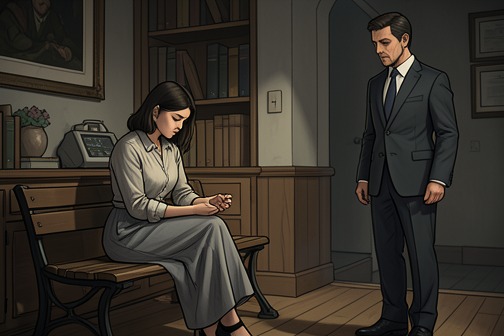
[Eric Doss](entity:character-recall-character-eric-doss-de052e8c34b0)’s disappearance from [Stanford](entity:location-recall-location-ead1b02dd0b4) becomes a family crisis when his father finds him sitting silently beneath a tree on campus. The episode links [Eric](entity:character-recall-character-eric-7ec3f96e28e6)’s unexplained absence to his grief over his mother’s death, while [Richard Doss](entity:character-recall-character-richard-doss-7dbc6ac5b105)’s fear that his son is repeating [Joanne Doss](entity:character-recall-character-joanne-doss-c7eeadd2109e)’s withdrawal turns a missing student into a source of urgent concern about the family’s emotional collapse.
## Warning Signs and Discovery
The first news reaches [Alex Delaware](entity:character-recall-character-alex-delaware-5f082af49613) through [Milo Sturgis](entity:character-recall-character-milo-sturgis-2f67268d5cc2), who explains that [Stacy Doss](entity:character-recall-character-stacy-doss-952f6955a9e3) missed her session because she had gone to her father’s office. [Richard](entity:character-recall-character-richard-cc7ee1eeaeeb) had summoned [Milo](entity:character-recall-character-milo-885f1c74a004) to discuss another matter, but [Stacy](entity:character-recall-character-stacy-8e3c8bf1f57b) arrived with news about her brother. Her interruption makes Eric’s absence the immediate concern: he has left his routine at Stanford, and the family does not yet know where he is.
Milo follows the lead beyond what he learned in Richard’s office. He contacts Stanford, locates Eric’s dorm, and speaks with his roommate, Chad Soo. Chad reports that Eric had seemed depressed for several days and had then failed to return to the room for a couple of days. The absence was prolonged enough to be noticed, but Chad hesitated to raise an alarm because he did not want to get Eric in trouble. What changed his mind was a missed test: Eric had failed to appear for an exam, behavior Chad regarded as unlike him. Only after the second day did Chad contact the family, reaching Stacy.
## Stacy’s Explanation and Grief
Stacy initially reaches for a memory that might make Eric’s absence intelligible without making it a crisis. The family dog, [Helen](entity:character-recall-character-helen-25ca9ab47439), had been a yellow mutt adopted from a pound. As Helen grew old and lost the use of her legs, Eric built a small wagon and pulled her around; when she died, a year before Joanne, he stayed out all night with her. Stacy connects that history to Eric’s account of doing his best thinking late at night in the mountains. She imagines that he may have gone there under stress, and supposes he could make up the missed exam by talking to his professor.
Her reassurance gives way to a more direct admission. Eric, she says, is having a very hard time with their mother’s death and had struggled with it from the beginning; he took it worse than Stacy did. She suspects Richard would not have described his son’s grief that way. The contrast matters: a daughter who first explains Eric’s absence through his familiar habits then acknowledges how little she may know about the depth of his distress. Helen’s death offers a precedent for Eric keeping vigil through the night, but his current silence and disappearance are not resolved by that resemblance.
## Richard Finds Eric
Richard eventually locates Eric at four in the morning on the Stanford campus. Eric has not left the university: he is sitting in an out-of-the-way spot beneath a tree and has apparently been there for a long time. Richard brings him back to [Los Angeles](entity:location-recall-location-los-angeles-11eff639bdf5) by plane. Eric has missed several exams, but Richard tells [Alex](entity:character-recall-character-alex-ad819204cb8d) that the academic consequences do not matter to him; he wants Alex to see his son.
The recovery does not restore communication. Eric will not speak to Richard, either when he is found or after his return. Richard describes him as sitting in place and shutting his father out, but distinguishes the silence from a loss of awareness: Eric makes eye contact, seems fully present, and has normal muscle tone when touched or moved. Richard therefore reports a disturbing refusal to engage, not an inability to respond. His request for Alex’s help arises from that distinction: Eric is physically back with his family, yet remains inaccessible to his father.
## Family Fears and the Aftermath
Richard’s fear is sharpened by a comparison with Joanne. He says he cannot help thinking that Eric’s behavior resembles the way Joanne began to pull away. The parallel is Richard’s anxious interpretation, not a diagnosis or proof that Eric is following the same course. Still, it casts the silent figure beneath the tree in a painful family context: Richard has already watched withdrawal become part of his wife’s decline, and now recognizes a pattern he dreads in his son.
Richard has brought Eric home but asks Alex to take on the next step, requesting that he see the young man. He also wants the episode kept from Stanford, worried that the university might regard Eric as damaged goods. Richard says that only Chad knows so far and that he has urged the roommate to keep the matter confidential. The insistence on secrecy sits beside Richard’s appeal for help: he wants Eric treated, but fears that the fact of his crisis could follow him back to school. The episode ends not with an explanation for Eric’s absence, but with his return to Los Angeles, his continued silence, and a father trying to secure help without exposing his son.
Event 6
Mate Portrait Abandoned at a Gallery
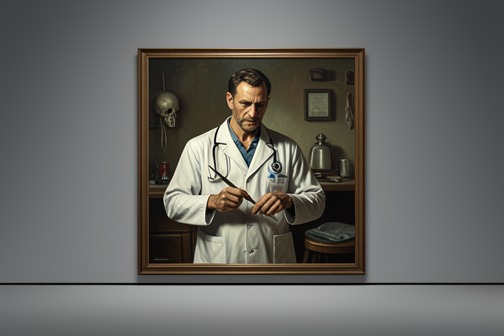
[Mate Portrait Abandoned at a Gallery](entity:event-recall-event-45806aa4ec7b) introduces a disturbing object into the investigation of [Eldon Mate](entity:character-recall-character-eldon-mate-fa61505a7baf)’s murder: an unsigned painting that turns Mate into both the body on the dissection table and the figure cutting into it. Its unexplained delivery made the artwork a potential clue, while its imagery gave the crime a new, public form.
## Discovery and the public account
The painting surfaced at Primal Images, an art gallery on Colorado Avenue in [Santa Monica](entity:location-recall-location-santa-monica-ce3bc4267c60). Grant Kugler, the gallery’s owner, arrived the previous night to unpack an installation and found what the newspaper called a surprise donation propped against the rear door. Wrapped in brown paper, the package contained an original, unsigned oil painting described as a copy of Rembrandt’s *[The Anatomy Lesson](entity:expression-recall-expression-the-anatomy-lesson-4734dcb94af7)*. It followed the source painting’s dissection-room arrangement but altered its central image: the murdered physician Eldon Mate appeared twice, as the cadaver and as the dissector. The delivery’s placement and anonymous character left the reason for choosing Kugler’s gallery unresolved; he said he could not explain why it had been left there and described himself as more interested in social commentary than representational art.
The front-page article, headed *The Mysterious Portrait of Dr. Death*, reported that unnamed police sources saw intriguing similarities between the painting and details of the Mate crime scene. It presented those correspondences as grounds for questions, not as proof of who had made the work or why its maker had abandoned it. The report said the painting had been taken into police custody, shifting it from an unexplained gallery donation into evidence associated with the murder investigation. The public account therefore established both a concrete investigative development and a conspicuous gap: the image connected itself to the crime, but its unsigned surface and unexplained arrival disclosed neither an artist nor a motive.
## The painting as evidence
The investigation then brought the canvas into the Robbery-Homicide room on the second floor of the West L.A. station. [Milo Sturgis](entity:character-recall-character-milo-sturgis-2f67268d5cc2) had it propped on a chair among half a dozen detectives hunched over their desks, making the image an object of police scrutiny rather than merely a newspaper sensation. Its arrival had produced no clear answer about authorship or purpose, but the close examination sharpened what the picture itself communicated.
The palette was almost entirely browns and blacks, with muted light and only a thin wash of pink at the dissected left arm, where the flesh had been reduced to tendons and ligaments. The corpse had Eldon Mate’s soft, fussy face. Seven elaborately robed, ruffed, and goateed men looked down at him with academic detachment, while a second Mate, dressed in a black robe, white lace collar, and tall black hat, probed the arm with a scalpel and wore an expression of boredom. By assigning Mate both roles, the painting made him simultaneously the object of scrutiny and the agent of dissection.
The contrast with Rembrandt’s original supplied the picture with much of its force. Where the original’s artistic mastery could distract from the cruelty of the dissection, [Zero Tollrance](entity:character-recall-character-zero-tollrance-8949e04288c2)’s less accomplished version made that violence difficult to look past. Angry, swirling brushstrokes and thickly laid pigments rose into sharp peaks from the canvas; the result was less a polished historical tableau than a blunt, unsettling transformation of the familiar composition. The form did not settle whether the painter meant accusation, mockery, or something more personal, but it turned the medical scene into an image of violence and fixation.
[Milo](entity:character-recall-character-milo-885f1c74a004) reported that the painting bore not a single fingerprint, a detail that strengthened the possibility of a careful maker without identifying one. He asked [Alex Delaware](entity:character-recall-character-alex-delaware-5f082af49613) whether seeing the work suggested anything beyond rage toward Eldon Mate or ambivalence about him. [Alex](entity:character-recall-character-alex-ad819204cb8d) offered no further interpretation. The image could make those opposing feelings visible, but it could not resolve who had painted it, why it had been left at the gallery, or how its creator was connected to the murder.
## The publicity-stunt possibility
Milo Sturgis also considered a less psychological explanation: Zero Tollrance might be a struggling artist exploiting Eldon Mate’s murder to revive a fading career. If Tollrance appeared on television the next day with an agent and publicist, Milo reasoned, the painting could be treated as a publicity stunt rather than evidence of a deeper fixation. Alex Delaware countered that Tollrance’s failure to appear would itself be suggestive, though it would not establish what the silence meant.
The competing possibilities leave the portrait’s central mystery open. Its treatment of Mate supports readings of both rage and ambivalence, yet neither the painting’s public notoriety nor the lack of an obvious commercial follow-up identifies its maker or explains the abandonment. The artwork raises questions the investigation can pursue, but supplies no final answer about the artist’s purpose.
## From Headline to Evidence Room
The portrait’s passage from newsprint to police evidence was also a shift in how Alex Delaware encountered it. After reading the front-page account, he expected Milo Sturgis to get in touch; the call came while Alex had finished only half a cup of coffee. Milo invited him to view the painting in the evidence room, and Alex accepted, remarking that representational art was his interest. The brief exchange turned a startling public report into a direct encounter with the canvas, bringing Alex into the investigation at the point where the image could be examined rather than merely reported.
Event 7
Richard Doss Allegedly Hires a Hitman to Kill Mate
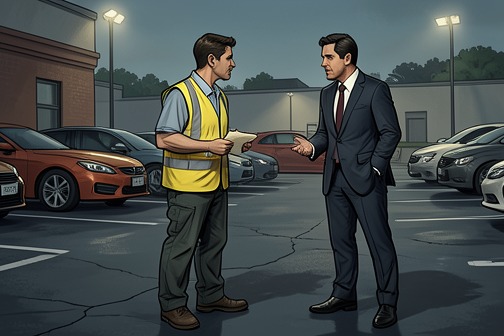
[Richard Doss Allegedly Hires a Hitman to Kill Mate](entity:event-recall-event-a5ea4bd4cdfe) centers on a murder-for-hire accusation that transforms Doss from a grieving husband into the leading suspect in [Eldon Mate](entity:character-recall-character-eldon-mate-fa61505a7baf)’s killing. The account comes from [Quentin Goad](entity:character-recall-character-quentin-goad-01f4248ee004), an imprisoned armed-robbery defendant, and is strengthened by witnesses who saw Doss meet him and pass him an envelope. Yet Goad admits that he took the money as part of a scam, so the evidence points toward an arrangement without resolving whether Doss’s plan ever advanced beyond an offer.
## The Alleged Arrangement and Goad’s Account
Goad was being held at County awaiting trial for armed robbery when [Milo Sturgis](entity:character-recall-character-milo-sturgis-2f67268d5cc2) presented him to [Alex Delaware](entity:character-recall-character-alex-delaware-5f082af49613) as a possible link to Mate’s murder. Goad also worked in construction, specializing in roofing and sheet-metal jobs, and had done work for Doss. According to Sturgis, Doss regularly hired formerly incarcerated workers and paid them under the table, a practice that could explain both Goad’s access to him and the difficulty of distinguishing a criminal payment from ordinary work-related cash.
Goad said that about two months earlier he had been roofing a large shopping center in San Bernardino that Doss had bought cheaply and was renovating. He alleged that Doss offered him $5,000 to kill Mate, specifying that the killing should be nasty and bloody so investigators would attribute it to a serial killer. The proposed payment was divided into $1,000 up front and $4,000 after the job. Goad said he accepted the advance but never intended to carry out the murder: he regarded the offer as an opportunity to cheat Doss and leave for Nevada, where he hoped to escape the pressure of having two prior strikes against him in California.
Goad’s explanation makes him both the source of the accusation and a compromised witness. He claimed that Doss later pressed him for a progress report, about three weeks after the initial approach, and that he answered by saying he was watching Mate and waiting for the right opportunity. Goad denied that this was true; he described the supposed surveillance as part of his con. The distinction mattered to the investigation: if Goad was telling the truth about the offer, Doss had sought a hired killer, but Goad’s account did not establish that he had stalked Mate or attempted the murder himself.
## Witnesses, Money, and the Limits of Corroboration
The allegation did not rest on Goad alone. Milo Sturgis told Alex Delaware that three patrons and a bartender remembered a serious, face-to-face meeting between Goad and [Richard Doss](entity:character-recall-character-richard-doss-7dbc6ac5b105) in a San Fernando bar frequented by ex-convicts. Doss stood out in the room: his expensive black clothes made him conspicuous among the bar’s clientele. A waitress said she saw him pass Goad a large envelope. She did not see cash itself change hands, leaving a gap between the witnesses’ observation and the payment Goad described, but the encounter gave investigators independent grounds to take his story seriously.
Sturgis also said police had recovered two of the ten hundred-dollar bills Doss allegedly gave Goad. Goad claimed to have spent eight bills and kept the remaining two for Greyhound fare, money to carry him until he could attempt a robbery. Police had taken Doss’s fingerprints and were checking the recovered bills, but the result was not yet known. The cash therefore offered a potentially testable link, not a completed forensic confirmation. Sturgis’s suspicion that Doss might have paid other former convicts for illicit work drew force from his reported practice of hiring them off the books, while also complicating any attempt to interpret a payment between employer and worker as proof of murder solicitation.
Goad’s arrest supplied another measure of his reliability. About a month before the interview, he had tried to rob a San Fernando hamburger restaurant shortly before closing, taking a .22 and a paper bag and getting as far as putting the money inside. A security guard subdued him and shot him in the leg; the wound was superficial, and he spent two weeks receiving treatment at County General Hospital before being transferred to the Twin Towers jail. The gun was not loaded. The failed robbery fit Goad’s own account of a man seeking money to leave California, but it also underscored how little confidence investigators could place in his claims. He was an armed-robbery defendant with an obvious incentive to deceive, and the proposed killing remained an allegation supported by circumstantial corroboration rather than a completed attempt.
## The Claimed Motive Against the Crime Scene
Goad said Doss justified the proposed killing by accusing Mate of having murdered Doss’s wife: in Goad’s account, Doss insisted she had not really been sick and that Mate, as her doctor, should have talked her out of ending her life. He reportedly framed killing Mate as a public service. This was Goad’s report of Doss’s rationale, not independent proof of either the accusation or Doss’s motive; still, it gives the alleged contract a specific grievance, tying it to Mate’s role in the wife’s death rather than to a financial dispute. The contrast with the crime scene sharpens the accusation without identifying the killer. Mate had been butchered in his van near Doss’s home. Investigators found no blood outside the vehicle, though the front seats were heavily bloodstained, and inferred that the killer had worked in the confined space, then changed clothes and carefully removed traces. Cardboard cut to cover the windows was streaked with arterial blood, while a mattress lay beneath Mate. The scene suggested that Mate had arrived prepared to assist someone’s death, only for the roles to be reversed. That reconstruction lends a grim context to the revenge Goad attributed to Doss, but it does not establish that Doss arranged the killing or that the alleged contract produced the murder.
## The Crime Scene and the Investigation’s Wider Course
The physical evidence at the murder site did not independently connect Richard Doss to the killing. Milo Sturgis considered whether the killer had arrived with Eldon Mate or had parked farther down the road, but investigators had found no other tracks, and no one had reported seeing another vehicle. The van itself had sat there for hours without attracting notice. With so little reliable evidence about how the killer reached or left the scene, the forensic uncertainty left room for the murder-for-hire allegation without confirming it.
The investigation later moved beyond Doss’s alleged approach to Quentin Goad. Milo Sturgis met Alex Delaware below the murder site, and the two followed a lead involving [Tanya Stratton](entity:character-recall-character-tanya-stratton-53a09fd04bc6)’s vehicle registration and address. Their search took them to a remote cabin, reached by a winding dirt track and screened by trees; the old sycamores there recalled the tree where [Alice Zoghbie](entity:character-recall-character-alice-zoghbie-a0f70d1a0bd7) and [Roy Haiselden](entity:character-recall-character-roy-haiselden-e2db99e659c6) had been propped. The visual echo redirected attention toward the broader pattern of killings and Paul Ulrich, rather than furnishing proof that Doss’s alleged contract had produced Mate’s death. The accusation remained consequential, but it was one contested strand in an investigation whose physical clues and changing leads continued to point elsewhere.
Event 8
Richard Doss Taken in for Police Questioning over Mate's Murder
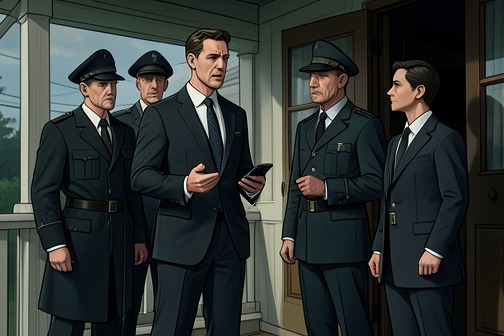
[Richard Doss Taken in for Police Questioning over Mate's Murder](entity:event-recall-event-cdd40b4f25f1) marks the moment the investigation reaches [Richard](entity:character-recall-character-richard-cc7ee1eeaeeb)’s home: Detectives [Steve Korn](entity:character-recall-character-steve-korn-be7613d29476) and [Brad Demetri](entity:character-recall-character-brad-demetri-e1d8d45a99ea) ask him to accompany them to the station, and the family is left facing an unexplained police inquiry. The scene stops short of an arrest, but Richard’s urgent effort to reach his lawyer and the distress of [Stacy Doss](entity:character-recall-character-stacy-doss-952f6955a9e3) and [Eric Doss](entity:character-recall-character-eric-doss-de052e8c34b0) give the departure the weight of a family emergency. At the West L.A. station, [Milo Sturgis](entity:character-recall-character-milo-sturgis-2f67268d5cc2) warns [Alex Delaware](entity:character-recall-character-alex-delaware-5f082af49613) not to speak, carrying the tension from the porch into the next stage of the investigation.
## The detectives arrive at the house
The episode begins with a small disruption of the expected schedule. The bell rings eight minutes early, and [Alex](entity:character-recall-character-alex-ad819204cb8d) wonders whether Richard is simply overeager. When Richard calls through the intercom, he apologizes for interrupting and reports that there is a problem outside. Alex and [Eric](entity:character-recall-character-eric-7ec3f96e28e6) hurry to the door, where Richard stands on the porch with [Stacy](entity:character-recall-character-stacy-8e3c8bf1f57b) and two tall men: Detectives Korn and Demetri. The sudden change in the household’s routine becomes a public encounter with the investigation.
Richard tells Alex that the detectives want him to accompany them to the police station. His wording leaves the legal status of the request unsettled until Korn clarifies that Richard is not being arrested and can make his call from the station. Demetri’s instruction to ride with them nevertheless makes clear that the detectives expect him to go. The scene therefore holds two facts in tension: Richard is being taken in for questioning, but the officers expressly distinguish that from an arrest.
## Richard’s call and his children’s reaction
Before leaving, Richard insists on calling his lawyer. He uses the silver phone and asks Saundra to put Max on the line, then presses for the call to be made immediately. He says that he is in a jam, but that it is something different and he cannot explain it at that moment; he tells her he will be at the West L.A. police station with detectives and asks that Max be reached in Aspen as soon as possible. The call establishes Richard’s immediate priority—legal help—without revealing what he understands the police to suspect or what he intends to tell his lawyer.
The children experience the encounter differently from Richard. Stacy looks at her father and asks what is happening, but he does not answer her or ask the detectives to explain their purpose in front of the children. Alex wonders whether Richard is trying to keep them from hearing the answer; the narration presents that as an interpretation, not a confirmed explanation. As Richard places the call, Eric moves beside Stacy and puts an arm around her. She reaches across his chest, while her lips quiver and a vein in Eric’s neck races. Their physical closeness contrasts with Richard’s effort to manage the practical next step.
Richard’s manner appears controlled, though not wholly easy to read. His foot taps while he waits on the phone, and Alex observes that the fear he had noticed earlier is gone. Whether this composure means he is calm under pressure or was not entirely surprised by the detectives’ arrival remains unresolved. Before going, Richard reassures the children that he will be all right and promises to see them for dinner. Stacy’s repeated appeal to him and her tears make that promise a fragile point of reassurance rather than a resolution.
## From the porch to the station
The event’s immediate consequence is Richard’s departure with the detectives, not a stated arrest or a disclosed account of the evidence against him. The distinction matters: the family witnesses a coercive, unsettling intervention, while the officers maintain that he is not under arrest. Richard’s quick attempt to secure Max’s help sharpens the uncertainty rather than dispelling it, since he names a serious predicament but withholds its particulars from Saundra and the children.
The next station scene shifts attention to Alex and [Milo](entity:character-recall-character-milo-885f1c74a004). At 5:23, Alex is in the front reception area of the West L.A. station when Milo has just come down the stairs. Milo raises a hand inches from Alex’s face and, barely audibly, tells him not to say anything. The warning does not explain what Milo has learned, but it carries the episode’s uncertainty forward: Richard has been brought in, and Alex is now cautioned to hold his tongue. The movement from a family porch to a police-station reception area turns the questioning into a broader investigative moment, while leaving its immediate grounds and outcome undisclosed.
Event 9
Ann Arbor Campus Attacks and Murders
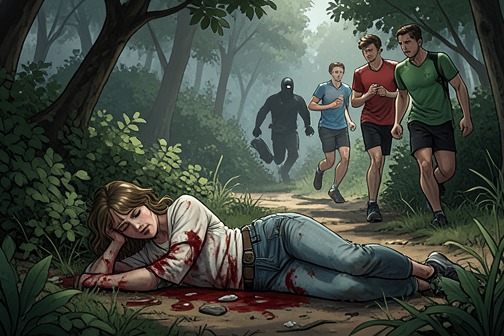
The [Ann Arbor Campus Attacks and Murders](entity:event-recall-event-1d1ed9c824ca) were a series of assaults on women jogging at night near the University of Michigan campus. Recounted years later by Fusco as part of his effort to trace a pattern of mutilation crimes, the incidents connected two surviving victims to a third woman who was killed, while leaving investigators without a viable suspect at the time.
## Background and Course
During the year between Irma Huie’s death in [Syracuse](entity:location-recall-location-syracuse-bf81ac0ea6df) and [Michael Burke](entity:character-recall-character-michael-burke-eb7b545161f5)’s enrollment at the [City University of New York](entity:organization-recall-organization-422932df0f17), a cluster of attacks began in Michigan. They started four months after Mitchell Sartin left Colorado. Two coeds were attacked from behind on campus-adjacent pathways by a masked man who knocked them down, beat them, sexually assaulted them, and used a sharp knife to stab and slash them. Both survived because other joggers came upon the scenes, prompting the assailant to flee into nearby bushes. Three months later, as some of the campus panic had subsided, another young woman was taken; her body was found near a reservoir.
## The Third Victim and the Investigative Pattern
The third victim’s death turned the campus attacks into a murder investigation. Her body was discovered near a reservoir, with extensive injuries indicating a deliberate assault. Her wrists and ankles had been bound to a tree with thick hemp rope; evidence at the scene showed that she was alive during at least part of the attack. A wound to the jugular was recorded as the official cause of death. The details suggested not a sudden loss of control but a sequence carried out with time and preparation.
Shreds of blue paper found nearby gave investigators a possible material link: they eventually matched the pieces to disposable surgical scrub suits then used at the University of Michigan Medical Center. Interviews with medical-school staff and students produced no serious lead, however. The clue pointed toward an institutional setting without identifying who had obtained or worn the clothing, leaving the investigation with a suggestive trace but no suspect it could substantiate.
## Survivor Testimony and Retrospective Identification
The surviving women could not identify their attacker by face or voice: he concealed himself, remained silent, and was described only as a strong, medium-built white man. One remembered a glimpse of pale skin between his sleeve and glove. Their account of his method was more specific. He seized a victim from behind, used a choke hold, then struck her three times in quick succession. [Leimert Fusco](entity:character-recall-character-leimert-fusco-045bf15c9dae) demonstrated the sequence with his fist against his open palm, emphasizing its controlled, almost mechanical rhythm rather than a loss of temper.
One survivor, Shelly Spreen, later described the attack as calculated. Leimert Fusco interviewed her fourteen years afterward. She had undergone reconstructive surgery, which restored much of her appearance but did not erase the damage; she was married, had two children, and was willing to discuss what had happened. Her testimony gave Fusco a rare opportunity to revisit the case through a survivor’s account, though it had not produced a lead for the original investigators.
Fusco’s eventual identification was a retrospective hypothesis, not a suspect established by the Ann Arbor investigation. Working backward, he looked for young men in their twenties who might have worked in security or at the university and then disappeared from view. The only person he found who fit that outline was Huey Grant Mitchell, an orderly in the University of Michigan medical school’s cardiac unit. Fusco connected the name to Michael Burke through a chain of invented identities: Mitchell Sartin and Grant Huie Rushton supplied its elements, while the supposed Phoenix hospital reference proved false and the Social Security number on the job application had only recently been issued. The Ann Arbor rental had been paid for in cash, leaving virtually no paper trail; the lone employment record described Mitchell as an excellent orderly. These details supported Fusco’s theory of an increasingly confident offender, but they did not turn the earlier investigation’s lack of a serious lead into proof.
## Place in the Wider Pattern
In Fusco’s retrospective account, the Ann Arbor crimes matter not only as an unsolved campus case but as a possible link in a larger sequence: he says their features resemble those of the [Denver](entity:location-recall-location-denver-bd410fc030e8) victim, then uses that resemblance to reconstruct a path toward Michael Burke. The shift is consequential but not conclusive. Ann Arbor investigators had found no serious lead, and Fusco’s later identification rests on patterns, records, and an assembled identity rather than a witness recognition or a resolved original case. The episode therefore marks both the reach and the limit of retrospective profiling: details that once seemed isolated can acquire significance beside later crimes, while the connection remains a theory that must not be mistaken for proof.
Event 10
Fresno Trail Murders
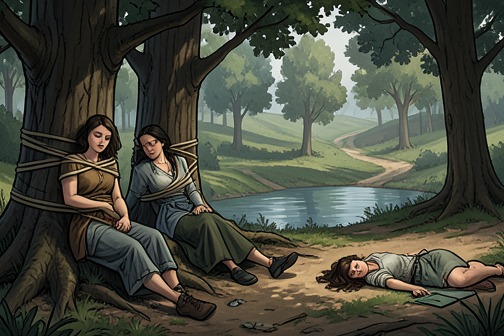
The [Fresno Trail Murders](entity:event-recall-event-e3f588d7bf8b) were two killings on hiking trails that expanded an emerging series of attacks across Colorado, Michigan, and California. The victims were found two weeks apart, bound to trees and killed in ways investigators considered nearly identical to the earlier cases. [Fresno](entity:location-recall-location-fresno-17a843235137) thus mattered not only as the setting for two deaths, but as a point where a geographically scattered pattern began to acquire a more traceable history.
## Place in the Emerging Pattern
The Fresno killings occurred about a month after Huey Mitchell left Ann Arbor. The timing and the close resemblance between the victims’ circumstances and those in Colorado and Michigan connected the California cases to the earlier attacks. The bodies were discovered separately, two weeks apart, but their repeated similarities suggested a series rather than unrelated crimes.
That pattern helped investigators look beyond the immediate locations of the killings. The Fresno cases became part of a wider inquiry into an offender whose trail crossed state lines and whose history included work in medical settings. Their significance lay in how they strengthened the case for reading the murders together.
## Hank Spreen and the [Bakersfield](entity:location-recall-location-bakersfield-7becd8116e5e) Hospital
Five weeks after the second Fresno victim was found, hospital orderly Hank Spreen left town. Before his departure, he had worked at a private Bakersfield hospital specializing in cosmetic procedures and cyst removals. Three patients who had undergone procedures there died suddenly during the night over a six-month period.
The deaths had been officially attributed to heart attacks or idiopathic reactions to anesthesia. Each explanation was possible on its own, but the recurrence of three such deaths at one hospital raised suspicion. The resulting publicity contributed to the hospital’s closure; Spreen, however, had already gone.
## The Investigation’s Retrospective Link
When investigators reconstructed the broader sequence, Spreen’s departure and the hospital deaths gave the Fresno murders a medical context beyond the similarities among the victims. In the account of the investigation, Spreen was also connected to the name of an earlier victim, Shelly Spreen, a detail treated as a grim act of irony. The pattern therefore involved not just repeated locations and methods, but the apparent reuse of identities.
The chronology continued the following summer, when [Michael Burke](entity:character-recall-character-michael-burke-eb7b545161f5) appeared at CUNY. Burke’s subsequent education and employment in hospitals became part of the investigators’ account of his background. The Fresno cases occupy a pivotal place in that reconstruction: they precede Spreen’s departure and the later emergence of Burke, while the hospital deaths supply a separate line of suspicion that investigators consider alongside the trail murders.
## Significance
The Fresno killings turn a cluster of similar crimes into a widening investigation whose clues include timing, repeated circumstances, a suspect’s departure, and unexplained deaths in a medical workplace. The evidence establishes the cases’ connection to the emerging pattern and the importance of the Bakersfield hospital history; it does not, by itself, detail the Fresno crime scenes beyond the victims’ discovery and the similarity to earlier murders. Their narrative force comes from this accumulating structure: two killings, a departure weeks later, and a trail that eventually leads investigators toward Michael Burke.
Event 11
Attempted Poisoning of Selwyn Rabinowitz
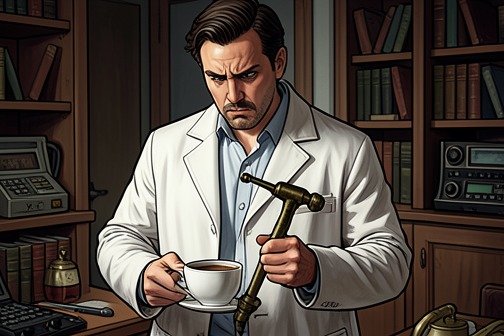
The [Attempted Poisoning of Selwyn Rabinowitz](entity:event-recall-event-d337dd67e725) is a past crime recounted through a newspaper report and detectives’ review of [Michael Ferris Burke](entity:character-recall-character-michael-ferris-burk-5fd974a7909f)’s history. Rabinowitz survived after taking only a sip of poisoned coffee, but the case established a serious, unresolved suspicion against Burke: a physician accused of using medical knowledge to try to kill a former supervisor, then gone when police sought to question him.
## Background and Motive
At the time of the incident, Rabinowitz chaired the Department of Emergency Medicine at [Unitas Critical Care Center](entity:organization-recall-organization-unitas-critical-8dfedf21f529) in [Rochester, New York](entity:location-recall-location-8cd63e1d9de7). Burke, a 38-year-old emergency-room physician, had recently been suspended by Rabinowitz over what the newspaper described as questionable medical practices. The report also said Burke had made veiled threats against his superior. Those circumstances supplied a possible motive, but they did not by themselves establish that Burke had poisoned him.
The incident came to light for [Alex Delaware and Milo Sturgis](entity:relation-recall-relation-alex-delaware-and-mi-0e4498e53988) through a news item dated fifteen months earlier and filed from [Buffalo, New York](entity:location-recall-location-88cc34561369). Its headline, Doctor Suspected in Attempted Murder, announced an accusation rather than a conviction. The article said police were seeking Burke in connection with an alleged attempt to lace Rabinowitz’s drink with a lethal combination of toxic materials. In the detectives’ later discussion, the suspected poison was identified as cyanide.
## The Poisoning
Rabinowitz drank one sip of the doctored coffee and became ill almost immediately. The speed of his reaction made the danger plain, but he survived. The original report described him as hospitalized in stable condition; the later account supplied a fuller measure of the aftermath, stating that he spent a month in hospital despite having swallowed only a small amount. The attempt failed, but it was not a harmless or merely speculative threat: it left Rabinowitz seriously ill and under medical care for weeks.
The poisoning was linked to Burke through a chain of circumstances. He was the last person known to have been near Rabinowitz’s coffee cup, apart from Rabinowitz’s secretary, who passed a polygraph. Burke had already been suspended and had reportedly threatened his superior. When local police tried to question him and administer a polygraph, he had left town. Taken together, the timing, the prior conflict, and his absence gave investigators grounds for suspicion, but the account does not describe a direct witness to the poisoning or a definitive forensic finding placing the act in his hands.
## Evidence and Uncertainty
The evidence involving syringes and a penicillin ampule was especially suggestive—and qualified. The newspaper reported that several syringes and vials had been recovered from a locker in the physicians’ lounge, while noting that police would not say whether they belonged to Burke. In the later discussion, investigators specified that needles and a penicillin ampule were found in another doctor’s locker, with traces of cyanide in the ampule. That colleague had been at home with stomach flu, had not left the house, and had witnesses supporting the alibi; suspicion that he too had been poisoned proved unfounded. The discovery therefore pointed toward cyanide in the hospital setting without establishing that Burke owned the materials or that the other doctor was involved.
[Leimert Fusco](entity:character-recall-character-leimert-fusco-045bf15c9dae) characterized the poisoning case as circumstantial. Its force lay in the convergence of Burke’s conflict with Rabinowitz, the victim’s sudden illness, Burke’s proximity to the coffee, and his departure before questioning. Its weakness was equally important: the reported physical evidence was found in a colleague’s locker, and the account supplied no direct proof that Burke had prepared or administered the poison. The distinction prevents suspicion from being mistaken for a settled finding.
## Place in the Wider Investigation
The attempted poisoning matters to the later inquiry because it makes Burke a suspect with an earlier history of alleged medical violence, not because it proves that he committed the subsequent crimes under investigation. Fusco also directs attention to [Roger Sharveneau](entity:character-recall-character-roger-sharveneau-d610a4315228), a certified respiratory technician who had worked at Unitas for three months during the same period as Burke. Sharveneau mentioned Burke; a week later, Sharveneau was dead. Buffalo police had not investigated Sharveneau’s account of Burke. The timing makes the neglected lead consequential, but it does not establish that the poisoning and Sharveneau’s death had the same perpetrator or cause.
In this way, the case functions as both a warning and an evidentiary limit. Burke’s professional access to medical materials and the reported attempt on Rabinowitz invite investigators to consider a pattern, while the unresolved details resist a simple verdict. The episode sharpens the question of what Burke may have done without answering it: an old accusation becomes newly significant when another witness who spoke of him is found dead, yet the connection still requires proof.
Event 12
Joanne Doss found dead at Happy Trails Motel
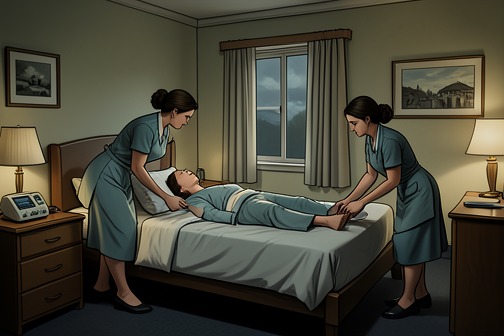
[Joanne Doss’s death](entity:event-recall-event-joanne-doss-f2bd56f024fc) at the [Happy Trails Motel](entity:location-recall-location-happy-trails-motel-6ee9016361a6) is presented first as a likely assisted suicide and then as a case that resists that explanation. The evidence points toward [Eldon Mate](entity:character-recall-character-eldon-mate-fa61505a7baf)’s methods, yet the missing signs of his usual involvement leave the death uncertain. As [Alex Delaware](entity:character-recall-character-alex-delaware-5f082af49613) searches for an account of Joanne’s final night, details of her marriage and the family’s fear about [Eric](entity:character-recall-character-eric-7ec3f96e28e6) deepen the question of who was responsible.
## Discovery and Initial Findings
A report attributed to Dr. Mate’s Machine and datelined [Lancaster](entity:location-recall-location-lancaster-e1b38f14e0d9) describes a motel maid finding Joanne’s fully clothed body while entering a room to clean it early in the morning. Joanne, 43, was from [Pacific Palisades](entity:location-recall-location-pacific-palisades-54855509c507); the report identifies her as the wife of a businessman and the mother of two. There were no reported sightings of Eldon Mate’s van nearby, but the first physical findings seemed to point toward his involvement.
Toxicological analysis detected two drugs that the report said Eldon Mate used consistently. Puncture marks suggested that the drugs had been injected intravenously, while the absence of forced entry or a struggle gave investigators no immediate indication of an assault. Those details led sheriff’s detectives to suspect assisted suicide. The finding was an inference from the scene and the drugs, however, not a confirmed account of who administered them or how Joanne came to be in the room.
The lead investigator, David Graham, described the scene as peaceful: classical music was playing on the radio, and Joanne had eaten a last meal. He understood that Eldon Mate encouraged patients to listen to music. Together, the music, meal, and apparent lack of struggle made the room legible as a planned death, but they did not establish who had arranged it. The quiet scene offered an impression of deliberateness without resolving the central question of agency.
## The Pattern That Does Not Fit
The report said Joanne’s health had been deteriorating and that she would be the forty-eighth person whose death Eldon Mate had facilitated. It also noted his success in avoiding conviction and his most recent indictment, concluding that criminal charges were unlikely. Yet the public record stopped there: [Alex](entity:character-recall-character-alex-ad819204cb8d) found no follow-up and not even an obituary. Eldon Mate did not claim credit, and Alex could find no additional account of Joanne’s final night in the available data.
That silence mattered because Alex had seen a pattern in Eldon Mate’s other cases. Three patients with definitive diagnoses had been associated with three van trips and three public statements; Alex believed Eldon Mate sought press attention. Joanne’s death offered neither a reported van sighting nor a statement. An earlier motel case, involving Lou Gehrig’s disease patient Reynolds Dobson at the Cowboy Inn near [Fresno](entity:location-recall-location-fresno-17a843235137), had occurred two years before. Against that history, the motel setting alone could not explain why Joanne’s death appeared both consistent with Eldon Mate’s work and conspicuously unlike its public pattern.
Alex’s conclusion was not that the initial account had been disproved, but that it failed to settle the matter. The drugs and injection marks supported the investigators’ suspicion; the missing publicity and van sighting weakened the expected pattern of attribution. The gap between a plausible method and an absent public claim turned the sparse report into a problem of interpretation. By the forty-eighth death, the lack of attention itself became part of what needed explaining.
## Lancaster in [Richard](entity:character-recall-character-richard-cc7ee1eeaeeb)’s Account
[Richard Doss](entity:character-recall-character-richard-doss-7dbc6ac5b105)’s recollection gave Lancaster a personal history absent from the report. He said Joanne had never gone there before that night, although he had spent many hours in the area working on projects, building shopping centers, and traveling from [Los Angeles](entity:location-recall-location-los-angeles-11eff639bdf5) by helicopter to Palmdale before driving the rest of the way. He remembered asking, even begging, her to visit: he wanted her to see what they were accomplishing, have lunch, and share the inexpensive, casual meals they had enjoyed when they were dating. She always refused, citing the distance, traffic, dryness, heat, or busyness.
Richard returned to the contrast that she had resisted all those invitations and nevertheless ended up in Lancaster. His account did not identify how she arrived at the motel or establish that he knew the circumstances of her death. Instead, it attached a history of disappointed invitations to the place where she died. His abrupt, bitter laughter gave way to a suppressed sob; in that moment, Lancaster was no longer just a location in a police report, but the setting of a painful reversal in the couple’s shared history.
## Competing Possibilities and Family Fear
The question of how Joanne reached the motel remained open. Alex considered whether she could have managed the death herself: she was a microbiologist with access to lethal chemicals and the skills to inject herself. But her physical condition made it difficult for him to imagine her driving to Lancaster alone. He also considered the possibility that Eldon Mate had been there after all, perhaps returning to rented rooms at Joanne’s request and keeping the death private for the sake of the children. These remained possibilities, not established facts; even Alex recognized that the proposed reason for secrecy did not sit comfortably with the conspicuous choice of a motel suicide.
A further source of fear arose when Alex connected Eric’s account of killing the family dog, [Helen](entity:character-recall-character-helen-25ca9ab47439), with his talk about putting people out of their misery. Alex raised the possibility that, if Eric could kill Helen, he might have done something similar to a person, including his mother. [Stacy](entity:character-recall-character-stacy-8e3c8bf1f57b) first denied the suggestion and then confirmed that Eric had hinted at it without directly confessing. She recalled his description of Helen looking up at him and licking his face before he struck her once with a rock, and his insistence that the dog had been sick and that ending her suffering was necessary. This disclosure established that Eric had spoken in ways that frightened Stacy; it did not prove that he caused Joanne’s death. The report’s apparent assisted-suicide scenario thus remains unsettled, caught between evidence consistent with Eldon Mate’s practice, a husband’s grief-stricken recollection, and a daughter’s account of her brother’s disturbing hints.
Event 13
Richard Doss Arrested in Connection with Mate's Murder
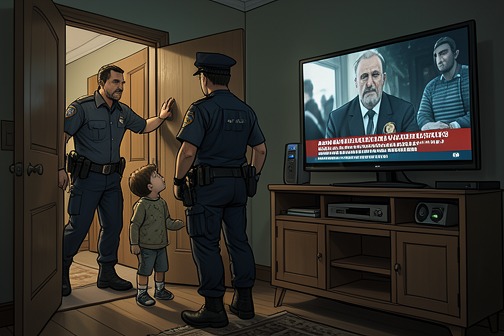
[Richard Doss](entity:character-recall-character-richard-doss-7dbc6ac5b105)’s questioning in connection with [Eldon Mate](entity:character-recall-character-eldon-mate-fa61505a7baf)’s murder turns a private investigation into a public crisis. Police take him from his home in front of his children; a television report identifies him as the man being questioned and links the case to Mate’s assistance in [Joanne Doss’s death](entity:event-recall-event-joanne-doss-f2bd56f024fc). The report also raises, without confirming, a possible murder-for-hire scheme. [Richard](entity:character-recall-character-richard-cc7ee1eeaeeb) is home again hours later, but police attention and press coverage have already made suspicion part of the family’s immediate life.
## The Police Visit
[Alex Delaware](entity:character-recall-character-alex-delaware-5f082af49613) tells [Robin Castagna](entity:character-recall-character-robin-castagna-40578626c745) that [Steve Korn](entity:character-recall-character-steve-korn-be7613d29476) and [Brad Demetri](entity:character-recall-character-brad-demetri-e1d8d45a99ea) came to his home. [Robin](entity:character-recall-character-robin-68c0d1985feb) reacts with alarm when she learns that they took Richard away in front of his children, and asks how [Milo Sturgis](entity:character-recall-character-milo-sturgis-2f67268d5cc2) could have done that. Her response registers the human cost of the investigation: whatever the strength of the suspicion, Richard’s removal was witnessed by his family.
The visit also intensifies [Alex](entity:character-recall-character-alex-ad819204cb8d)’s own conflict. He is carrying [Leimert Fusco](entity:character-recall-character-leimert-fusco-045bf15c9dae)’s extensive file and feels the pull to pursue the [FBI](entity:organization-recall-organization-c3b9c0848e8c) agent’s case in search of evidence that might exonerate Richard. He recognizes that he wants a decisive discovery partly because it could restore Richard in the eyes of [Stacy Doss](entity:character-recall-character-stacy-doss-952f6955a9e3) and [Eric Doss](entity:character-recall-character-eric-doss-de052e8c34b0), and make Alex himself seem like a hero to them. Instead of returning immediately to that effort, he sits with Robin and turns on the television.
## The Story Becomes Public
A breaking-news banner announces that police are questioning Richard in the murder of Eldon Mate. The report identifies Richard as a forty-six-year-old wealthy [Pacific Palisades](entity:location-recall-location-pacific-palisades-54855509c507) businessman and as Joanne’s former husband. It says that Mate assisted Joanne’s suicide nearly a year earlier, supplying the personal connection that makes Richard’s possible involvement legible to viewers.
The report carefully distinguishes suspicion from established fact: police sources describe a possible murder-for-hire scheme, but say it has not been confirmed. Richard’s attorney, [Joe Safer](entity:character-recall-character-joe-safer-d47b9b99b67f), has arrived at the West [Los Angeles](entity:location-recall-location-los-angeles-11eff639bdf5) police station. The camera shows the building Alex has just left, and he realizes the news crew must have reached it moments after his departure. The investigation is no longer confined to police interviews and private conversations; it is being presented as a developing public story while key claims remain unverified.
## Aftermath at the Doss Home
Later, while stopped for gas on Wilshire, Alex uses a pay phone to return a call from Safer, who had called from the Doss home number. Safer reports that Richard and the children are home. Richard had arrived four hours earlier, and Safer waited for the press commotion to subside before calling. By then, the reporters and most of the police have left, but an unmarked car remains parked down the block. Safer says the two men inside are the same officers who had confronted Richard at Alex’s home.
Richard’s return marks a change in the immediate circumstances, not a resolution of the case. He has been taken away and questioned, then returned to a home still watched by police. The report’s murder-for-hire allegation remains unconfirmed, and the evidence presented here does not establish that he has been charged or cleared.
## Significance
The episode sharply contrasts the family’s private shock with the news broadcast’s brisk, simplified account. Robin focuses on Richard’s children witnessing the police removal; television reduces the event to an update about a businessman, a dead doctor, and an unconfirmed scheme. Alex is caught between his personal wish to vindicate Richard and the investigative pressure surrounding Mate’s murder. The officers’ continued surveillance, even after Richard is back with his family, leaves suspicion unresolved and keeps the police encounter active beyond the moment of questioning.
Event 14
Richard Doss's Attempt to Hire a Hitman to Kill Mate
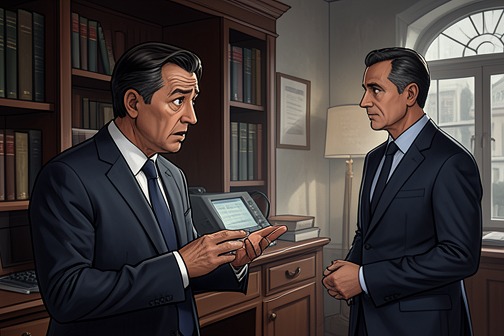
[Richard Doss](entity:character-recall-character-richard-doss-7dbc6ac5b105)’s attempt to hire [Quentin Goad](entity:character-recall-character-quentin-goad-01f4248ee004) to kill [Eldon Mate](entity:character-recall-character-eldon-mate-fa61505a7baf) is revealed not as a completed attack but as an act [Richard](entity:character-recall-character-richard-cc7ee1eeaeeb) tries to shrink into a forgivable error. In conversation with [Alex Delaware](entity:character-recall-character-alex-delaware-5f082af49613), he admits paying Goad to murder the “death doctor,” then frames the episode as folly and insists that he learned from it. The contrast between the gravity of the plan and Richard’s insistence that nothing happened makes the attempt a measure of his need to control both events and their meaning.
## The admission and its target
Richard’s admission identifies the essential act: he paid Quentin Goad to kill Eldon Mate. The intended victim was the doctor who had helped [Joanne Doss](entity:character-recall-character-joanne-doss-c7eeadd2109e) die, a source of Richard’s anger after her death. In [Alex](entity:character-recall-character-alex-ad819204cb8d)’s interpretation, Richard felt aggrieved and wanted retribution; the attempt belonged to a conflict in which Richard’s sense of injury could become a license for violence. The evidence establishes the hiring and its intended target, but does not describe an attack carried out by Goad. The distinction matters: Richard’s plan was murderous, even if he later insists that it produced no further action.
The surrounding exchange shows how Richard handles the admission. He speaks of the arrangement as a hypothetical matter and brushes it off as an act of folly, while Alex recognizes that this account is not the whole story. Richard’s explanation does not erase the decision to seek Mate’s death; instead, it makes the effort to minimize that decision part of the event’s significance. He wants the act treated as finished and inconsequential, although its target and purpose remain unmistakable.
## A defense taking shape
Richard’s conversation also turns toward diminished capacity. Alex hears the possibility of a temporary-insanity defense in the way Richard discusses his mental state, and Richard acknowledges that such a defense might become relevant. The exchange suggests that legal mitigation is already present in his thinking, rather than an explanation introduced only after the fact. The attempt is therefore accompanied by a second kind of preparation: Richard is not only describing what he says he did, but anticipating how his conduct might be judged.
That preparation complicates his effort to call the episode a mistake. Richard’s account is selective: he characterizes himself as sufficiently impaired to raise temporary insanity, but also presents himself as someone who recognized the error and stopped. Alex does not accept that framing at face value. He notes that Richard had an alibi prepared and was already talking about a defense, details that make the calm dismissal less reassuring. The conversation does not establish the legal outcome or settle every question about Richard’s mental state; it shows him trying to shape the interpretation before the investigation has run its course.
## The children and the language of minimization
Richard shifts the discussion from his own conduct to its possible effect on his children. He says that, whatever he can manage about his own peccadilloes, the children need help. The choice of scale is revealing: murder-for-hire is reduced to a personal failing, while the family’s needs become the more pressing subject. Richard’s concern may be genuine, but it also redirects attention from the intended victim and toward the consequences Richard fears within his own household.
When Alex questions the claim that nothing happened, Richard’s insistence grows more emphatic. He recasts the proposed arrangement as well-trained, well-paid babysitting, explaining it as care for the children until matters settle down. The euphemism converts a troubling family arrangement into a practical service, just as his earlier language converts a murder solicitation into folly. In both cases, his wording tries to make an alarming situation manageable by renaming it. The children’s welfare becomes a reason to discuss what Richard needs done around the family, rather than a resolution of what he did to Mate.
## Denial, contradiction, and significance
Richard insists that he did not actually do anything, that he learned from his mistake, and that he did not try again. Alex’s response distinguishes the absence of a completed killing from the seriousness of soliciting one: a failed or abandoned plan is not the same as innocence. Richard’s denial concerns repetition and outcome; it cannot undo the original payment or the intended murder. His account thus depends on defining the event narrowly enough to exclude its most consequential fact.
Alex’s assessment hardens as he connects the denial to Richard’s preparations and temper. He sees a ruthless, self-centered man accustomed to control and convinced that he has been wronged. Richard’s anger at Mate is set against his attempt to present himself as repentant and finished with the scheme. This does not prove that he made a second attempt, but it gives Alex reason to distrust the assurance that there was none. The episode’s unresolved tension is between Richard’s claim that he stopped and the evidence of a man already arranging an alibi and contemplating a defense. His attempt to hire Goad therefore remains consequential even without an attack: it exposes how readily grievance became a plan for murder, and how insistently Richard tried to make that plan sound harmless.
Event 15
Marissa Bonpaine Murder
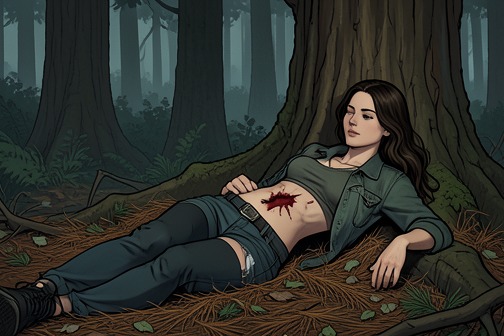
[Marissa Bonpaine Murder](entity:event-recall-event-marissa-bonpaine-dc88d808d91c) is a Washington State killing that turns a remote forest crime scene into a link between apparently separate murders. Bonpaine, a twenty-year-old waitress, was found dead a week after she was last seen serving shrimp cocktail at a stand in [Seattle](entity:location-recall-location-7af5814b411d)’s Pike Place Market. Her case was one of four killings from [Michael Ferris Burke](entity:character-recall-character-michael-ferris-burk-5fd974a7909f)’s years as a medical student that [Leimert Fusco](entity:character-recall-character-leimert-fusco-045bf15c9dae) judged consistent with Burke’s technique, in part because the victims had been left propped against or near trees.
## The Killing and Its Setting
A hiker discovered Bonpaine’s body splayed in front of a fir in a secluded area of [Olympic National Forest](entity:location-recall-location-76e7ff24b7cf). The forest floor, layered with pine needles and decaying leaves, might have preserved forensic traces, but investigators found no footprints near the scene. Eleven days of rain further diminished the prospect of recovering evidence, leaving the site as clean as the operating room the killer had intended it to be.
Bonpaine had suffered a slashed throat, abdominal mutilations, and sexual posturing. A deep trapezoidal wound above her pubic bone had rough edges, but its shape could still be read as geometrical; she died from shock and blood loss. She had no blunt-force head injury. Her small stature—four feet eleven inches and 101 pounds—meant she could have been subdued without being knocked unconscious. The scene and injuries suggested a killing in which the victim may have remained conscious, though that possibility was an inference rather than an established fact.
The investigation produced a large but largely unproductive inventory. After a hiker found the body, forest rangers and law-enforcement personnel from three departments searched a two-hundred-yard grid and recorded 183 items, mostly discarded objects such as cans, bottles, broken sunglasses, and cigarette butts. Investigators also collected animal remains, lead buckshot, and two bullets that were judged irrelevant because Bonpaine had not been shot. Boots and other discarded clothing were examined and dated to a period well before the murder. Amid this mass of incidental debris, one small item would later acquire significance.
## The Toy and the Hiker’s Identity
The case’s decisive clue emerged not during the original search but in a later rereading of the file. At 3:22 a.m., after working through the photographs collected in Leimert Fusco’s omnibus, [Alex Delaware](entity:character-recall-character-alex-delaware-5f082af49613) noticed a glint several feet to the right of Bonpaine’s left hand. The crime-scene inventory gave the object a prosaic label: item 76, a child’s toy hypodermic made by Tommi-Toy in Taiwan, originally part of a U-Be-the-Doctor kit imported between 1989 and 1995. It had been found 1.4 meters from the victim’s hand, with no fingerprints or organic residue.
The toy had been submerged in a list of 183 recovered objects, most of them rubbish, and the reports gave no indication that investigators had treated it as meaningful. Its absence of residue could suggest recent placement, but the possibility remained uncertain: rain might have washed traces away. The significance lay less in what the object could prove on its own than in how sharply it connected the scene to a medical identity. Fusco had grouped Bonpaine’s killing with four Washington State murders committed during Michael Ferris Burke’s medical-student years, citing a shared practice of leaving victims against or near trees. The toy offered a second, small-scale echo of that medical world, though the file did not establish who had put it there or when.
A separate detail, easy to miss in the paperwork, sharpened the connection. In a footnote, Detective Elias recorded that the body had been discovered by a hiker walking with a dog. The event list identified the hiker as Ferris Grant, a tourist from Michigan, and supplied an address and telephone number in Flint. It also described his dog, a black Labrador retriever, and noted that Grant said she had an unusually keen nose and seemed to think she was a drug dog.
That description rang familiar because Paul Ulrich had used the same words about Duchess, his golden retriever. Delaware followed the resemblance from the dog to the hiker’s name: Ferris Grant, then Michael Ferris Burke, with Grant Rushton also surfacing in the identification. The shift transforms an apparently incidental witness into a link between Bonpaine’s murder and the man whose killings Fusco had been studying. The realization arrives by accumulation—a toy in a photograph, a buried footnote, a dog described in nearly identical terms—rather than through a single spectacular discovery. When Delaware called the number listed for Grant’s home exchange, the recorded message identified the Flint Museum of Art, adding another point of contact but not, by itself, resolving the alias trail.
## Retrospective Identification and Evidentiary Limits
The case changes meaning through a retrospective reading rather than a new forensic test. The original investigation had gathered an unusually broad inventory, yet the toy remained an unremarked entry among discarded objects; the hiker’s identity, meanwhile, lay in a footnote and event list. Each clue was present in the record, but their significance depended on being read alongside details from other cases. The discovery therefore exposes not a lack of evidence so much as a failure, at first, to recognize which evidence belonged together.
The identification chain remains suggestive rather than self-proving. A dog description links Ferris Grant to Paul Ulrich, while the names Grant Rushton and Michael Ferris Burke bring the hiker into the orbit of the murders Leimert Fusco had attributed to Burke’s technique. The telephone number ending at the Flint Museum of Art adds a further point of contact, not a conclusive identification. Likewise, the toy hypodermic connects the scene to medical imagery but has no fingerprints or organic residue, and the rain leaves open whether any trace was washed away. The murder thus becomes a crucial lead precisely without becoming a closed forensic demonstration: its force lies in the convergence of overlooked particulars, and in the questions that convergence reopens.
## Narrative Function and Delayed Recognition
The murder’s place in the larger investigation emerges through a gap between when the evidence was collected and when it is understood. The inventory and Detective Elias’s event list preserve observations from the original inquiry; Alex Delaware’s later reading reorganizes them into a pattern. That shift makes the case turn not on a newly recovered object or a fresh forensic result, but on attention: details once filed separately become consequential when compared across the records. The reader follows the same change in scale, from a single body and its surrounding debris to a possible connection among killings and identities, while the evidence remains short of definitive proof.
Event 16
Double Murder of Alice Zoghbie and Roy Haiselden
The [Double Murder of Alice Zoghbie and Roy Haiselden](entity:event-recall-event-alice-zoghbie-roy-haise-58dda63d418e) is revealed through a carefully arranged scene that turns two deaths into a message. The bodies are bound to a tree, their hands joined, and a picnic basket with champagne and small jars stands nearby. The tableau makes the discovery central not only to the investigation but also to the question of what the killer intends others to understand.
## Discovery and Scene
The bodies are found in a small, enclosed backyard, screened from neighboring houses by Italian cypress hedges and a tall fence. A broad sycamore shades the yard; beneath it, [Alice Zoghbie](entity:character-recall-character-alice-zoghbie-a0f70d1a0bd7) and [Roy Haiselden](entity:character-recall-character-roy-haiselden-e2db99e659c6) are propped against the trunk. Thick rope secures both at the chest and waist, making their placement appear deliberate rather than incidental.
Their identities emerge from the scene. Zoghbie’s white hair helps identify her, while Haiselden is recognizable by his distinctive toupee. Three triangular marks are visible on each victim’s abdomen. Their hands are clasped together, a stark gesture of connection within a scene otherwise arranged to display the violence done to them. Nearby, a wicker picnic basket, a bottle of champagne, and two small jars add another composed element. Together, these details make the backyard feel like a staged setting, though the scene alone does not establish what the objects signify.
## Investigative Interpretation and Public Message
The discovery also changes the investigators’ understanding of the killings by linking them to the murder of [Eldon Mate](entity:character-recall-character-eldon-mate-fa61505a7baf) and to the struggle over who would control its meaning. [Alex Delaware](entity:character-recall-character-alex-delaware-5f082af49613) proposes that [Michael Burke](entity:character-recall-character-michael-burke-eb7b545161f5) may have killed Alice Zoghbie and Roy Haiselden not only to attract attention, but to obtain records that could incriminate him. The murders thus acquire a possible practical purpose alongside their public, theatrical effect: silencing witnesses or removing evidence could serve the same criminal design as the display itself.
Alex Delaware treats the timing as suggestive but not conclusive. Michael Burke may have planned the murders earlier, he reasons, while [Richard Doss](entity:character-recall-character-richard-doss-7dbc6ac5b105)’s arrest could have accelerated the plan: Burke would not want someone else credited with the killing of Eldon Mate. In that account, the double murder is bound to the investigation’s shifting public narrative, with the prospect of renewed press attention making the connection to the Mate case harder to contain. These are investigative hypotheses, not facts established by the crime scene.
Alex Delaware’s theory gives the victims’ deaths a further, deliberately unsettling meaning. He sees Michael Burke as trying to eliminate the old guard and announce himself as a new “Dr. Death,” combining the pursuit of attention with the removal of people and records that might threaten him. Yet the confidence of that reading is questioned: a colleague points out that [Leimert Fusco](entity:character-recall-character-leimert-fusco-045bf15c9dae) misrepresented himself. The exchange leaves the proposed motive compelling but still open to scrutiny, preserving a distinction between the apparent message of the murders and proof of who sent it.
## The Sequence of Recognition
The scene is filtered through Alex Delaware’s response: after seeing the two bodies, he struggles to steady himself, then shifts his attention to the objects set nearby. That movement matters to the investigation’s form. The victims are encountered first as people whose deaths demand explanation; only afterward does the basket, champagne bottle, and pair of small jars enter view as possible clues. The staged setting therefore works on two levels at once: it confronts the observer with an arrangement, but leaves the meaning of its separate elements to be tested rather than assumed.
This order also marks the difference between what the scene shows and what [Alex](entity:character-recall-character-alex-ad819204cb8d) later infers. The joined hands and the carefully placed objects make deliberate arrangement evident, but they do not, by themselves, establish the killer’s identity or explain the victims’ connection. Alex’s subsequent theory about Michael Burke gives the tableau a possible audience and purpose, while the challenge concerning Leimert Fusco’s misrepresentation cautions against treating a persuasive interpretation as proof. The murder scene remains both evidence and message, with its meaning dependent on an investigation that has not yet resolved who composed it or why.
## The Tableau and Its Limits
The joined hands give the scene an image of intimacy, but they do not explain the relationship between Alice Zoghbie and Roy Haiselden or establish what either wanted. That uncertainty matters: the arrangement invites interpretation without making its meaning self-evident. Alex Delaware reads the killings as a calculated public announcement, yet the evidence supports a distinction between the scene’s deliberate composition and the motive assigned to it. The backyard can be understood as a message, while its precise authorship and intended meaning remain questions for the investigation.
Event 17
Eric Doss Smashes His Father's Ceramic Collection
[Eric Doss Smashes His Father's Ceramic Collection](entity:event-recall-event-eric-doss-627fd781706a) is a domestic confrontation in which [Eric](entity:character-recall-character-eric-7ec3f96e28e6) reduces [Richard Doss](entity:character-recall-character-richard-doss-7dbc6ac5b105)’s prized pottery to rubble, then fights his father over a baseball bat. The destruction draws the family’s conflict into the open: the collection is broken, father and son grapple among its fragments, and the scene ends not with an explanation but with Eric’s tearful appeal for forgiveness.
## Background and Setting
The episode begins with the sound of breaking glass. [Alex Delaware](entity:character-recall-character-alex-delaware-5f082af49613) runs downstairs into the living room, where two figures in black are crouched in a combative stance. The reveal is immediate and physical: [Richard](entity:character-recall-character-richard-cc7ee1eeaeeb) is confronting his son, Eric, who is holding a baseball bat. Richard shouts, “What the fuck have you done?” The question registers the scale of the damage before the scene has fully shown it.
Behind Eric, the display cases have been ravaged. Their brass is dented; glass doors are splintered and jagged; shards and glittering dust cover the carpet. The pottery is broken both inside the cases and on the floor. Horses, camels, and small human figurines have been reduced to rubble. What had been a carefully displayed collection is now a field of fragments, and the room’s domestic order has given way to a scene of confrontation.
## The Destruction and Fight
Richard advances, breathing raspingly, while Eric grips the bat with both hands and warns him, “Don't even think about it.” When Richard orders him to put it down, Eric does not retreat. He laughs and swings again at the porcelain. Richard rushes forward and throws himself at the bat; the two struggle for control and fall to the floor among the glass and dust.
[Alex](entity:character-recall-character-alex-ad819204cb8d) dives in, aiming for the bat. He feels the hardwood, slick with sweat and grit, and the broken pieces crunch beneath his knees as he pulls at it. The struggle continues around him: Eric and Richard growl, spit, and flail at one another, while Alex takes a fist to the jaw and keeps hold. The fight is not simply an argument beside the wreckage; the broken collection becomes the ground on which the family’s conflict is physically enacted.
[Joe Safer](entity:character-recall-character-joe-safer-d47b9b99b67f) enters and orders them to stop. When they remain occupied with the bat, he threatens to leave permanently and abandon them to their misery. Richard is the first to stop. Eric continues to growl, but his grip loosens, allowing Safer and Alex to pull the bat away. Safer’s ultimatum changes the immediate stakes: the struggle ends not through a resolution between father and son, but when a third person makes his continued presence conditional on their stopping.
## The Ruins and the Appeal for Forgiveness
After the bat is taken away, Richard sits on the floor and lets the ruins of his collection fall through his fingers. He looks stunned, with small cuts on his face and hands and one swollen eye. Eric is on his knees a few feet away, staring at nothing; apart from a split lip, he has no obvious injury. Alex’s jaw throbs and is beginning to swell, though it is not broken. These injuries mark the fight’s cost without obscuring its central aftermath: Richard is left handling pieces of what was destroyed, while Eric appears emotionally spent.
When Richard asks what led Eric to do it, Eric answers with an apology: “Sorry, Daddy,” followed by repeated apologies. He begins to sob. Richard starts to comfort him, then thinks better of it and sits back down. Eric’s explanation is a single word: “Forgiveness,” followed by “[Forgiveness is all.](entity:expression-recall-expression-forgiveness-is-all-5fa250317012)” The exchange gives the destruction an emotional direction but not a full account of its cause. The scene does not specify what Eric wants forgiven, or establish that his father accepts the appeal. Instead, it sets Eric’s remorse beside Richard’s stunned silence and the irreparable evidence scattered across the room.
Richard picks up a fragment of pottery, green, blue, and chartreuse, containing part of a horse’s face. The small piece concentrates the scale of the loss: the collection that had stood whole in display cases is now something Richard can hold only as a fragment. A voice behind the group reacts, “Oh my God,” but the moment offers no quick restoration of what the fight has broken.
## Immediate Consequences
After the confrontation, Safer asks Alex to keep what he witnessed from being repeated, specifically including Detective [Milo Sturgis](entity:character-recall-character-milo-sturgis-2f67268d5cc2). He then returns to the question of [Stacy Doss](entity:character-recall-character-stacy-doss-952f6955a9e3), asking whether she should leave the house at least for the night. Safer offers his own home in Hancock Park, where he says there is room and his wife will not mind. His arrangements shift the scene from the immediate danger of the fight to the family’s short-term separation and privacy.
The episode therefore closes on containment rather than reconciliation. The bat has been removed, but the pottery remains smashed; Richard and Eric have stopped fighting, but the brief exchange does not settle the hurt between them. Eric’s repeated apology and invocation of forgiveness provide the scene’s most direct statement of need, while Richard’s hesitation to comfort him leaves the response unresolved. The wrecked collection makes that unresolved family rupture visible: the violence has ended, but its consequences remain in the room and in the family’s need to decide what happens next.
Event 18
Death of Victoria Fusco
[Victoria Fusco](entity:character-recall-character-victoria-fusco-7f517acc7796)’s death followed a childhood bone tumor, a later leukemia diagnosis, and a prolonged course of cancer treatment that ended when chemotherapy-weakened immunity left her vulnerable to pneumonia. Her death was neither wholly unexpected nor considered inevitable, and its unresolved circumstances became the defining wound in her father [Leimert Fusco](entity:character-recall-character-leimert-fusco-045bf15c9dae)’s life after the loss: months later, he came to believe that [Roger Sharveneau](entity:character-recall-character-roger-sharveneau-d610a4315228) or [Michael Burke](entity:character-recall-character-michael-burke-eb7b545161f5), or both, had caused it.
## Background and Earlier Illness
Five years before the account of Victoria’s death, Leimert Fusco’s wife died of breast cancer, leaving him the sole parent of their fourteen-year-old daughter. Victoria had herself been diagnosed with a bone tumor as a toddler. Treated at [Sloan-Kettering](entity:location-recall-location-sloan-kettering-b8aec81deb43), she appeared to have recovered. After his wife’s death, Fusco requested a transfer from his Bureau post in Midtown Manhattan, saying that he wanted to raise Victoria in a quieter environment. He moved to the [Buffalo, New York](entity:location-recall-location-88cc34561369), office and bought a home near Lake Erie. His transfer was described as an act of devotion to his daughter, not an effort to advance his career.
Victoria’s illness returned when she was sixteen. She developed leukemia, which the account identifies as apparently caused by the radiation she had received years earlier for the bone tumor. The sequence made her later cancer a consequence of treatment for an earlier cancer, turning what had seemed to be a successful recovery into a renewed medical crisis. Her return to illness also came after the family had already endured the death of her mother.
## Treatment and Death
Fusco began taking Victoria from Buffalo to New York for treatment at Sloan-Kettering. Her condition shifted through successive, incomplete reprieves: she entered remission, relapsed, received further chemotherapy, and achieved only a partial remission. She weakened, then improved with experimental drugs, but the improvement came alongside further physical weakness. The treatment history offered no simple progression toward recovery; each gain was compromised by relapse or the cost of continued treatment.
Fusco eventually decided to continue care closer to home, at a hospital in Buffalo. The immediate aim was to increase Victoria’s strength enough for her to tolerate a bone-marrow transplant back in New York. She improved for a time. Then chemotherapy had weakened her immune system, and she developed pneumonia. Her doctors hospitalized her, and she died there. The reported sequence links the pneumonia to her compromised immunity but does not claim that the infection was deliberately caused or that her death was medically certain in advance.
## Uncertainty Around the Outcome
When asked whether Victoria’s death had been expected, Donovan explained that it was not unexpected but was not inevitable either. That distinction preserves the uncertainty at the center of the event: Victoria was seriously ill and her death was a known possibility, yet the available account did not describe it as an unavoidable outcome. The possibility that she might have survived sits beside the certainty of her death, without resolving whether a particular person or act caused it.
The medical account also established why Fusco later focused on people who had been around the hospital. [Alex Delaware](entity:character-recall-character-alex-delaware-5f082af49613) asked whether Victoria had been cared for by Roger Sharveneau, a respiratory technician. The supplied account does not confirm that Sharveneau treated her or establish what he did in her room. It records Delaware’s question and, later, Fusco’s claim that he had seen Sharveneau on the ward when he had no good reason to be there. Those are important elements of Fusco’s suspicion, not proof that Sharveneau murdered Victoria.
## Aftermath and Fusco’s Suspicion
Fusco did not become convinced that Sharveneau or Burke had murdered Victoria until months after her death, when Sharveneau began confessing. Fusco claimed to recognize Sharveneau from the ward and to have seen him in Victoria’s room without an adequate reason. He tried to interview Sharveneau in jail, but Buffalo police refused permission: the Bureau had no standing in the case, and Fusco was regarded as personally involved. He reacted badly to that refusal and continued pursuing the matter after Sharveneau’s release, harassing Sharveneau’s lawyer. Even after Sharveneau died by suicide, Fusco did not stop.
The consequences reached Fusco’s career and judgment. His work deteriorated, and the Bureau sent him back to Quantico for several months to teach seminars to beginning profilers, partly as a cooling-off measure. He appeared calmer and more content, but that apparent improvement concealed continued research into Burke. Fusco used much of his energy accessing databases without permission. After his superiors brought him back to New York for a meeting, they dismissed him on disability pension. Victoria’s death therefore remains distinct from the later suspicions it generated: the account documents the illness and death, and the profound aftermath for her father, while leaving the accusation of murder unproven.
Event 19
Eldon Mate Murder
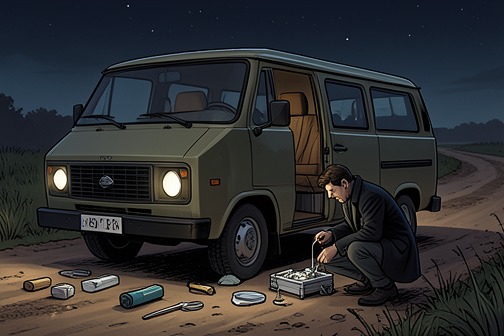
[Eldon Mate](entity:character-recall-character-eldon-mate-fa61505a7baf)’s murder turns an apparently empty stretch of [Mulholland](entity:location-recall-location-mulholland-3be5cc17a918) into a crime scene whose missing traces are as consequential as the evidence left behind. The early reconstruction presents a killing carried out inside Mate’s van with surgical precision and extraordinary care to conceal the work; only later does the investigation identify physician [Paul Nelson Ulrich](entity:character-recall-character-paul-nelson-ulrich-37408b5f0cd7), also known as [Michael Ferris Burke](entity:character-recall-character-michael-ferris-burk-5fd974a7909f), as the prime suspect and connect surgical equipment recovered from his cabin and storage locker to the case.
## Location and Initial Reconstruction
[Alex Delaware](entity:character-recall-character-alex-delaware-5f082af49613) set out at seven-thirty to reach the place where Mate had been butchered, driving north along Beverly Glen before turning west onto Mulholland. The route passed crowded commuter traffic and roadworks, then followed a winding road through brush and empty lots. After four miles, the terrain rose sharply; the road became packed ocher dirt as the asphalt continued east under the name Encino Hills Drive. The location was close to Delaware’s home, but its remoteness and darkness would complicate any reconstruction of who had come and gone.
At the scene, the investigators could not establish whether the killer had arrived with Mate, parked farther away than the area already checked, or left without producing useful tracks. No one had reported seeing another vehicle, but Mate’s van itself had sat there for hours without attracting notice. The lack of witnesses therefore offered little reassurance: it showed how a vehicle could remain in plain view and still escape attention, while leaving the killer’s route uncertain.
The physical evidence suggested that the murder took place in the confined interior of the van. The killer used an extremely sharp, single-edged blade, possibly a scalpel or straight razor, with scissors as a possible backup; the coroner considered the victim’s superficial cuts likely accidental slips during the bloody work. Yet no blood was found outside the van. Blood marked the front seats, especially the passenger seat, and arterial streaks on sheets of thick cardboard cut to cover the driver’s-side windows indicated that the panels had been used during the cutting. Investigators inferred that the killer had used portable light, moved between the van’s sides to clean up, changed clothes, and swept the surrounding ground before leaving, but the precise sequence remained a reconstruction rather than a witnessed account.
## The Cabin and the Doctor’s Bag
The later search shifted attention from the van to a secluded cabin near the coast. [Alex Delaware and Milo Sturgis](entity:relation-recall-relation-alex-delaware-and-mi-0e4498e53988) found the entrance by an overgrown mailbox; the dirt track wound through dense trees before the cabin appeared, barely visible behind pines, gum trees, and sycamores. The old sycamores recalled the tree where [Alice Zoghbie](entity:character-recall-character-alice-zoghbie-a0f70d1a0bd7) and [Roy Haiselden](entity:character-recall-character-roy-haiselden-e2db99e659c6) had been propped, a resemblance that made the setting feel potentially significant to the investigators. [Milo](entity:character-recall-character-milo-885f1c74a004) urged caution, preferring to watch the cabin rather than announce their presence. The first inspection yielded no obvious trophies, and a more thorough search found little of evidentiary value beyond a doctor’s bag.
The bag was old, burnished leather, its clasp marked with the gold initials EHM. [Tanya Stratton](entity:character-recall-character-tanya-stratton-53a09fd04bc6) said she had never seen it; Delaware believed her, reasoning that Paul Nelson Ulrich had kept it hidden and brought it out only when he was ready to use it. Inside were scalpels, scissors, other instruments, intravenous tubing, sterile needles in several gauges, gauze, disposable injectors, and labeled ampules. Two identified substances, thiopental and potassium chloride, connected the medical equipment to the means of death and to the assisted-death practice associated with Eldon Mate. The initials offered a further, direct link: the bag appeared to have belonged to Mate, although the sheriff’s detective who took custody of it never asked what they stood for, and Milo did not volunteer the answer.
The search party later approached the ridge with deputies who feared the shooter might still be nearby. The wounds on Ulrich, including the size of the exit wounds, indicated a high-velocity bullet, probably fired from a military rifle fitted with a good-quality scope. In a storage locker, investigators found several well-maintained rifles and handguns, ammunition, and two sets of surgical tools, one Japanese and one American. Together with the equipment at the cabin, these discoveries made the connection between Ulrich and Mate’s killing substantially more concrete, while the suspected shooter’s skill and preparation remained evident in the circumstances of his own death.
## Identification, Public Account, and Retrospective
The public account connected the murder investigation to the [Malibu](entity:location-recall-location-malibu-60c95425040a) police shooting of Paul Nelson Ulrich, a forty-year-old physician. County sheriff and [Los Angeles Police Department](entity:organization-recall-organization-los-angeles-poli-a9203f111481) sources identified Ulrich as the prime suspect in Eldon Mate’s murder, citing evidence recovered at the shooting scene and elsewhere, including surgical tools believed to be the murder weapons. They said the evidence indicated that Ulrich had acted alone. The reports also identified him as a licensed physician in New York State under the name Michael Ferris Burke, while emphasizing that the circumstances of his shooting remained under investigation.
The case’s central motive remained unresolved in the official account: authorities had not put forward a reason for the killing. Sources suggested that Ulrich may have been mentally ill, but presented this as a possibility, not a settled finding. In November, Alex Delaware looked back on the investigation and recognized how often his guesses had been wrong. He tried to reach Tanya Stratton, received no answer, and then spoke with her sister, [Kris Lamplear](entity:character-recall-character-kris-lamplear-a4a8d2d00b9d), who was more forthcoming but did not recognize his voice. The final account thus sharpened the identification of Mate’s killer while leaving motive—and the full meaning of Ulrich’s actions—unanswered.
## The Intended Roles Reversed
The murder scene also suggested a reversal of the encounter Mate had expected. Investigators suspected the killer had brought the cardboard panels used to block the van’s windows, as well as the mattress beneath Mate, rather than relying on Mate’s own preparations. Their reconstruction was that Mate had arrived ready to assist another person’s death, as he had done many times before; instead, the would-be patient became the killer and Mate the victim. The scene’s medical equipment and makeshift privacy thus served not only as tools of concealment but as remnants of a plan whose roles had been violently inverted.
Event 20
Murders of Alice Zoghbie and Roy Haiselden
The murders of [Alice Zoghbie](entity:character-recall-character-alice-zoghbie-a0f70d1a0bd7) and [Roy Haiselden](entity:character-recall-character-roy-haiselden-e2db99e659c6) are recalled through the placement of their bodies: they had been propped against an old, twisted sycamore. Later, while [Alex Delaware and Milo Sturgis](entity:relation-recall-relation-alex-delaware-and-mi-0e4498e53988) approach a cabin through dense trees, [Alex](entity:character-recall-character-alex-ad819204cb8d) recognizes a similar tree and considers whether Paul Ulrich, also known as [Michael Ferris Burke](entity:character-recall-character-michael-ferris-burk-5fd974a7909f), had noticed the resemblance. The echo turns the remembered scene into a possible clue about how the killer arranged and understood his surroundings.
## The remembered scene
The passage supplies one precise detail about the murders rather than reconstructing their course: Alice Zoghbie and Roy Haiselden had been propped against a sycamore. The tree is described as old and twisted, an image that later returns in a different setting. The evidence does not specify the victims’ wounds, the method of killing, or the circumstances in which their bodies were placed there.
## The echo near the cabin
During the present investigation, Alex and [Milo](entity:character-recall-character-milo-885f1c74a004) leave the road and walk roughly a thousand feet before a gray clapboard cabin comes into view through pine, gum, and sycamore trees. One of the sycamores recalls the tree associated with the victims. Alex wonders whether Paul Ulrich had registered the parallel, imagining that he might have appreciated its symmetry and irony; this remains Alex’s inference, not a confirmed statement of Ulrich’s thoughts.
## Narrative significance
The murders return as a visual pattern embedded in the landscape. A tree that once marked the victims’ placement now becomes a point of comparison on the approach to the cabin, allowing Alex to connect the earlier crime with the investigation’s present setting. The resemblance sharpens suspicion without, by itself, proving that Ulrich deliberately repeated or recognized the image.
Event 21
Marissa Bonpaine Murder Case File
The [Marissa Bonpaine Murder Case File](entity:event-recall-event-011d6a67a82d) records the killing of a twenty-year-old waitress in [Seattle](entity:location-recall-location-7af5814b411d) and becomes a crucial link between an old series of unsolved murders and the present investigation. Its importance lies not in a proven identification of the killer, but in the pattern [Leimert Fusco](entity:character-recall-character-leimert-fusco-045bf15c9dae) saw across the cases—and in a detail [Alex Delaware](entity:character-recall-character-alex-delaware-5f082af49613) later recognizes as potentially useful to the person stalking a hiker on [Mulholland](entity:location-recall-location-mulholland-3be5cc17a918).
## The Victim and Crime Scene
Marissa Bonpaine was last seen serving shrimp cocktail at a stand in Pike Place Market. A week later, she was found splayed in front of a fir tree in a remote part of the [Olympic National Forest](entity:location-recall-location-76e7ff24b7cf). The crime-scene photograph that catches [Alex](entity:character-recall-character-alex-ad819204cb8d)’s attention shows a case Fusco had included among four Washington State killings committed during [Michael Burke](entity:character-recall-character-michael-burke-eb7b545161f5)’s time as a medical student.
The forest floor was thick with pine needles and decaying leaves, a surface that might have preserved forensic evidence. None was recovered. Eleven days of rain had passed, leaving the scene, in Alex’s description, as clean as an operating room. The circumstances make the absence of evidence part of the case’s character: the setting might have held traces, but weather and time had erased whatever investigators could have found.
The killing was exceptionally violent. Marissa’s throat had been slashed, her abdomen mutilated, and her body arranged in sexual posturing. A single deep, roughly edged trapezoidal wound above the pubic bone had a geometric shape. She died from shock and blood loss. The distinctive wound would later make the crime resonate with Alex as he reviewed the file.
## A Pattern, Not a Proven Identification
Fusco regarded four murders from Burke’s medical-school years as consistent with Burke’s technique, in part because the victims had been left propped against or near trees. Marissa’s body, found in front of a fir, fit that reported pattern. The file therefore offers a resemblance that guides suspicion, not proof that Burke committed the murder.
The possible connection initially sits among other investigative uncertainties. When [Milo Sturgis](entity:character-recall-character-milo-sturgis-2f67268d5cc2) asks whether the matter has something to do with [Eldon Mate](entity:character-recall-character-eldon-mate-fa61505a7baf), Alex answers that the name under discussion is Burke; neither investigator can immediately explain why it sounds familiar. The exchange captures the case’s function in the inquiry: an old name and a pattern surface before their significance is clear.
## The File Returns to the Present
Alex studies the crime-scene photograph in Fusco’s omnibus at 3:22 on a Thursday morning, having finished the collected material without reaching a decisive conclusion. On a later return to the file, he notices a notation by the first Seattle officer on the scene, detective Robert Elias, who had been called by the forest rangers who found the body. The notation is printed in small type at the bottom of the page and cross-referenced to a footnote. The evidence available here does not state its contents, but its placement marks the overlooked detail as an important point in Alex’s renewed reading.
The case acquires immediate present-day force when Alex calls [Milo](entity:character-recall-character-milo-885f1c74a004), who is on Mulholland, staring at the dirt and wondering whether he has missed something. Alex considers whether the person waiting there had found the same detail in the original Marissa Bonpaine file. The suspected gunman had said he was flying to Seattle; Alex weighs two possibilities rather than resolving them. The man might have flown back to [Los Angeles](entity:location-recall-location-los-angeles-11eff639bdf5) to follow the hiker, or Seattle might have been a lie and he might never have left. In either version, Alex imagines a patient pursuer working through the case with the same obsessive attention he himself had applied to it.
## Significance and Limits
The murder’s narrative significance comes from the way an archived crime scene becomes active evidence again. A photograph, a tree-side body, and a small cross-reference in an old file connect the Washington killings to the tense present on Mulholland. Yet the connection remains inferential: the shared detail may explain how the gunman found his opportunity, but Alex’s competing explanations remain possibilities, not confirmed events.
Event 22
Joanne Doss's Suicide at the Happy Trails Motel
[Joanne Doss](entity:character-recall-character-joanne-doss-c7eeadd2109e)'s suicide at the [Happy Trails Motel](entity:location-recall-location-happy-trails-motel-6ee9016361a6) in [Lancaster](entity:location-recall-location-lancaster-e1b38f14e0d9) is presented not as a fully witnessed scene but as a death pieced together afterward from a motel employee's account and [Alex Delaware](entity:character-recall-character-alex-delaware-5f082af49613)'s confrontation with [Judy Manitow](entity:character-recall-character-judy-manitow-c4ec2e03b740). The reconstruction establishes that Joanne checked herself in, was visibly unsteady, and had someone with her whom a witness later described. Its emotional center is the possibility that Joanne's companion was not simply there to comfort her: [Alex](entity:character-recall-character-alex-ad819204cb8d) interprets the visit as part of the punishment Joanne believed she deserved, while Judy's response suggests that the final meeting also carried an appeal for forgiveness.
## The Journey to Lancaster
Lancaster lies sixty-five miles north of [Los Angeles](entity:location-recall-location-los-angeles-11eff639bdf5), reached by the 405, the 5, and then the 14. The road narrows as it passes through the Antelope Valley toward the Mojave. The account marks the route with an austere progression: foothills, gas stations, truck stops, billboards, and low-cost housing give way to dirt and gravel before Palmdale. There were motels in Palmdale, but the narration stresses that those would not have served Joanne; the destination had to be Lancaster. That insistence makes the destination feel chosen rather than incidental, although the reason for choosing it is not explained in the passage.
Joanne made the drive late at night. From the car window, the landscape would have been almost entirely black, with little to look at and ample time to think. The narrative imagines her looking into that darkness, aware that the emptiness beyond the glass would be among her final images. It does not report what she thought or whether she wavered. Instead, it leaves those questions open, then focuses on a more intimate uncertainty: whether Joanne and the person with her spoke, and what a daughter could say to her mother when asked to help her leave. The absence of a reported conversation keeps the emotional particulars of the journey unknowable even as its destination and purpose become clear.
## Check-in and the Motel Account
Months later, Alex returned to the motel as part of a follow-up inquiry. The man he spoke with had not been working the night Joanne arrived; his son had been on duty. The father said the son had been visiting from Florida and covering for him while he was indisposed. By the time of this conversation, the son was back in Tallahassee, where he drove a truck for Anheuser-Busch. The information reaching Alex was therefore secondhand, carried through a father whose recollection of the night depended on what his son had told him.
That account nevertheless supplied concrete details. Joanne checked herself in, rather than arriving with someone to complete the transaction for her. The son, identified in the conversation as Barnett, reportedly thought she looked unwell and unsteady on her feet. She paid by credit card, and the police took the receipt. The father remarked that she was not the motel's usual kind of customer, a contrast that underscores how deliberately her arrival stood out to him. Nothing in this account specifies what she used to die or describes the final moments in the room; the evidence here concerns her arrival, condition, and independent handling of the check-in.
## The Companion Identified
The question of who accompanied Joanne emerges in Alex's later confrontation with Judy. Alex tells her that a witness saw her at the motel with Joanne, though the witness did not know her identity. The description was precise in some respects and limited in others: [Maribel](entity:character-recall-character-maribel-5956a1b68800) had seen the visitor's short yellow hair and remembered a thin woman with no visible backside, but had seen only her from behind as she got into a car. Maribel had come out to fill the ice machine. That ordinary errand supplied the observation that connected Judy to Joanne's last night.
Alex initially gives Judy a charitable interpretation: perhaps she had gone because Joanne had decided to die and needed a friend beside her. He immediately qualifies that possibility. Their friendship had cooled, and there was a reason for the distance. Alex then argues that Joanne's motive was crushing guilt over a sin she could not forgive herself for. [Richard Doss](entity:character-recall-character-richard-doss-7dbc6ac5b105) had not forgiven her, he says, and neither had Judy. On this reading, Judy's presence was more than companionship: Joanne may have wanted the person whose forgiveness she lacked to witness the end she had chosen. Alex compares the arrangement to the attendance of victims' relatives at an execution, making the motel visit an ordeal imposed on both women as well as a final act of self-destruction.
## Guilt, Punishment, and the Unanswered Apology
Judy does not answer Alex's reconstruction with a direct account of the night. Her physical response is small but telling: her lips fold inward, and her hand finds a walnut gavel among the objects on her desk. The handle bears a brass plaque, one award among the tributes lining the walls. Alex sees Joanne's request for Judy's presence as part of the punishment. The courtroom-like gavel in Judy's reach gives the confrontation a suggestive counterpoint, but the account does not make it proof of anything; the substance of Alex's claim rests on the witness's identification and on what Judy says next.
Judy calls Joanne's final act the first thing she had done right, then says Joanne wanted her to see it as a last chance at apology. The remark confirms the emotional significance Judy assigns to the encounter without explaining the original sin or resolving exactly what passed between them. Alex's earlier questions remain in force: whether they talked, what Joanne asked for, and whether Judy could or would offer forgiveness. The event thus ends in partial disclosure rather than a complete confession. Joanne's guilt is identified as the force behind her self-destruction; Judy's presence is tied to an attempted apology; but the underlying wrong and the details of their final conversation remain unstated.
## Narrative Significance
The suicide is reconstructed through gaps: a black road, a credit-card receipt retained by police, a motel employee's secondhand report, a witness who saw only the back of a departing woman, and Judy's compressed response. Those fragments shift the focus from method to relationship. Joanne's journey to Lancaster was solitary in appearance—she drove there late and checked herself in—but the account reveals that she was not alone in the emotional event. Judy was present, and Alex interprets her presence as both a witness to Joanne's chosen death and the recipient of an apology that came too late to repair their friendship.
The uncertainty is essential to the episode's force. The narrative does not stage Joanne's final hours as if an observer could recover them completely; instead, it makes the questions surrounding them part of the event's meaning. Her final image may have been darkness, but what that darkness meant to her is inaccessible. What can be established is that she traveled to Lancaster, arrived unsteady, and arranged her own check-in, while the later confrontation connects her death to guilt, estrangement, and the wish to be seen by someone she had hurt. Judy's words leave the attempted apology suspended between recognition and forgiveness.
Event 23
Discovery of Paul Ulrich's Storage Locker Contents
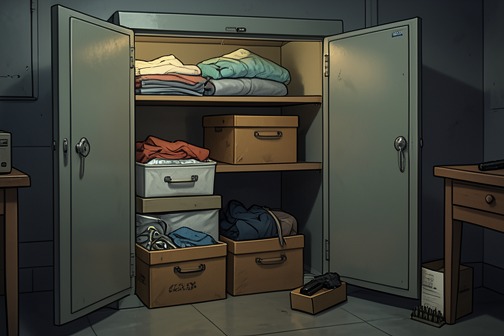
The discovery of Paul Ulrich’s storage locker contents turns a concealed cache into a material record of his double life: four carefully ordered cartons preserve traces of victims, clothing, possible trophies, and tools, while the locker’s cooling parcels and working firearms deepen the danger of what remains unknown. The investigation finds not a single decisive explanation, but an organized accumulation whose objects make Ulrich’s violence harder to treat as an isolated crime.
## Discovery and Investigative Context
A key found in Ulrich’s bedroom nightstand led investigators to a storage locker in [Panorama City](entity:location-recall-location-panorama-city-5587f6f785ea). The house itself had yielded nothing especially interesting, and [Tanya Stratton](entity:character-recall-character-tanya-stratton-53a09fd04bc6) had vacated the premises within days of the [Malibu](entity:location-recall-location-malibu-60c95425040a) shooting. The locker therefore offered a different kind of evidence: private material kept apart from Ulrich’s home and found through a small, practical clue rather than an obvious display.
By late November, a month and a half after [Eldon Mate](entity:character-recall-character-eldon-mate-fa61505a7baf)’s slaughter, [Milo Sturgis](entity:character-recall-character-milo-sturgis-2f67268d5cc2) had finished cataloguing the contents of the four cartons. The narration places that completed work weeks before [Alex Delaware](entity:character-recall-character-alex-delaware-5f082af49613)’s drive to [Lancaster](entity:location-recall-location-lancaster-e1b38f14e0d9), so the locker’s discovery and inventory reach the reader retrospectively. That delay matters to the unfolding investigation: a key opens onto an archive that has already been examined, but whose details now sharpen the meaning of Ulrich’s identity and the case against him.
The locker was rented in the name Dr. L. Pasteur. Its alias sits uneasily beside its methodical contents: the cartons were beautifully organized, and the objects within them had been preserved, sorted, or stored with care. The arrangement makes the cache more than a miscellaneous hoard. At the same time, the evidence does not explain every object’s origin or establish the contents of the wrapped parcels; the cataloguing reveals patterns and raises questions without resolving them all.
## Four Cartons of Evidence
The first carton held newspaper clippings folded and filed in chronological order, each tagged with a victim’s name. Among the material were meticulously preserved details of [Roger Sharveneau](entity:character-recall-character-roger-sharveneau-d610a4315228)’s suicide and the death of [Victoria Fusco](entity:character-recall-character-victoria-fusco-7f517acc7796), who had been a teenager. The clippings turn public accounts of death into a private index. Their chronological filing suggests sustained attention to the events, while the victim labels make the collection’s organizing principle unmistakable.
The second carton contained carefully pressed clothing, predominantly women’s undergarments, along with dresses, blouses, and neckties. The third held more than a hundred pieces of jewelry, each in a plastic sandwich bag. Most were of little value and some were vintage costume pieces; a few could be traced to dead people, while the origins of the rest remained unknown. Pressing, bagging, and sorting give these intimate, ordinary objects an unnerving stillness. Their careful storage contrasts with their uncertain provenance: the evidence connects some pieces to the dead but cannot account for all of them.
The fourth and largest carton contained a Styrofoam cooler. Inside it, parcels wrapped in butcher paper had been layered and preserved with dry ice. The storage-facility attendant remembered the renter as a friendly man with a large, old-fashioned mustache who came by roughly every week to make small talk about athletics, hiking, and hunting. By the time of the investigation, it had been a while since his last visit; much of the dry ice had melted, and the carton had begun to reek. The parcels were left for the coroner to unwrap. Their contents are not disclosed here, making the cooler both a concrete piece of evidence and an unresolved boundary around the investigation.
## Weapons, Tools, and the Case Against Ulrich
In a corner of the locker were several rifles and handguns, all oiled and in working order, together with boxes of bullets. The cache also included two sets of Japanese surgical tools and another set made in the United States. These items give the collection a more immediate forensic and practical dimension than the clippings and keepsakes: the guns were maintained and usable, and the surgical instruments echo the methods associated with Mate’s killing.
That echo has a specific investigative context. Mate was murdered in a van near Alex Delaware’s home, and [Milo](entity:character-recall-character-milo-885f1c74a004) had previously described a scene in which the killer took extraordinary care to keep blood from the ground, using the passenger side of the van to clean up before leaving. The police had no report of another vehicle, although the van itself had gone unnoticed for hours. The locker does not, by itself, prove who used any particular instrument or connect each stored object to a specific crime. It does, however, place surgical tools and a collection of victim-linked material in the possession of the man under suspicion for Mate’s murder.
## Interpretation and Aftermath
The attendant’s recollection makes the alias and the inventory more chilling by setting them against ordinary routine. The renter visited regularly, offered pleasantries, and spoke about familiar outdoor interests; behind that unremarkable social presence, the cartons preserved clippings, clothing, jewelry, and parcels requiring dry ice. The locker’s contents reveal concealment through organization rather than disorder. Each category has been separated and maintained, even where investigators cannot identify every item or yet know what the cooler contains.
The public account that follows frames the discovery in the language of police consequence: a newspaper headline describes the man killed in a police shooting as believed responsible for Eldon Mate’s murder. That framing makes the locker part of the case’s aftermath as well as a source of evidence. Ulrich’s death does not erase the questions stored in the cartons; instead, the inventory supplies investigators with a physical record to interpret after the suspected killer can no longer be questioned. The locker’s most disturbing effect is therefore cumulative: no single object tells the whole story, but their ordered presence turns a hidden storage space into an archive of violence, possession, and unresolved identification.
Event 24
Judy Manitow Discovers Joanne Doss Abusing Becky
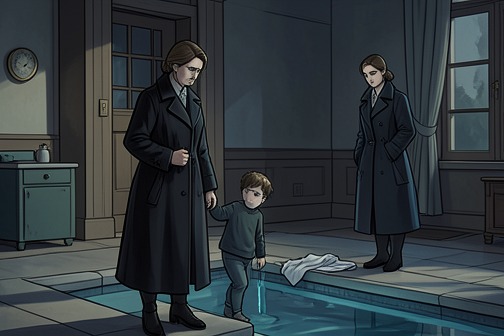
[Judy Manitow](entity:character-recall-character-judy-manitow-c4ec2e03b740)’s discovery that [Joanne Doss](entity:character-recall-character-joanne-doss-c7eeadd2109e) had abused [Becky](entity:character-recall-character-becky-b2d09bb6c315) transformed a trusted arrangement for tutoring into a betrayal within the family’s closest circle. Recounting the scene to [Alex Delaware](entity:character-recall-character-alex-delaware-5f082af49613), Judy describes not only finding Joanne and Becky together by the pool, but also the earlier changes that persuaded her the abuse was not an isolated incident.## The tutoring arrangement and discoveryJudy frames the violation through the labor and trust involved in raising a child. She recalls the years of physical care and daily attention that begin with pregnancy and continue through sleepless nights, tantrums, hurt feelings, bad habits, and puberty. Against that history, the betrayal was especially stark: Judy had entrusted her daughter to someone Becky had known her whole life, someone Judy herself had done favors for. The request had seemed ordinary and limited—tutoring in mathematics, because Becky was smart but struggled with numbers. The trust placed in Joanne made what Judy found feel like the destruction of something she had spent years building.Judy’s account fixes the discovery at the pool, where the scene contradicted the stated purpose of the tutoring. She found Joanne with Becky, while the math books lay wet on the deck and wet swimsuits were left in a heap. The details matter to Judy because they make the arrangement’s cover visible: the books were present, but soaked and displaced, while Joanne and Becky were together in circumstances that Judy understood as abuse. Her recollection moves from the evidence of that moment to the larger question of how long it had been happening.## Signs that the abuse had happened beforeWhen [Alex](entity:character-recall-character-alex-ad819204cb8d) asks whether it was the first time, Judy says Joanne and Becky both claimed that it was. She does not believe either of them, though she distinguishes their reasons: she regards Becky’s denial as rooted in shame and says she cannot blame her for it. Judy’s suspicion rests on a pattern of changes she had noticed after Becky turned sixteen and began receiving tutoring from Joanne. A girl who had once talked to her stopped doing so; Becky began crying for what seemed to be no reason and leaving the house without saying where she was going. Her grades also started to fall, even though the tutoring was supposed to help her academically.Judy retrospectively connects these changes to the abuse she uncovered. The shift in Becky’s behavior had appeared in ordinary family life—silence, unexplained distress, departures, and worsening school performance—rather than as a clear disclosure. Once Judy found Joanne with Becky, those earlier signs acquired a new meaning. She concludes that the abuse had not begun that day and allows that it may have continued for years, although she cannot establish its full duration.
## Silence, protection, and the aftermath
Judy’s account is not a request for Alex Delaware to investigate or expose what happened. She insists that she will tell him nothing he can repeat and warns that even the slightest hint of disclosure—to his wife or anyone else—will cost him his professional license. As she speaks, she springs up and paces repeatedly behind her desk, turning the boundary around her confidence into a physical show of agitation. Her anger at Joanne is inseparable from a determination to control who hears Becky’s story.
Asked whether she spoke with Becky after finding them, Judy says there was no point: Becky needed to heal, not be shamed. That response distinguishes silence intended to protect Becky from the denial that had concealed the abuse. Judy understands the girl’s earlier claim that it was the first time as shame-driven, and refuses to make disclosure another source of humiliation. The scene therefore ends not with a fuller account of what happened, but with Judy asserting both the seriousness of the harm and Becky’s need to recover without being put on trial.
## The shape and limits of Judy’s account
Judy’s recollection moves from a broad appeal to imagine the work of raising a child into a sharply bounded accusation about the trust she placed in Joanne Doss. That shift gives her account its force: the discovery is presented not as an isolated transgression between two people, but as a violation made possible by a relationship that had been allowed into family life. Her repeated return to the idea of Becky as something precious to be protected makes the betrayal legible in terms of what Judy believes has been damaged, while her pacing and abrupt insistence on secrecy show how difficult it is for her to recount the event without also trying to control its consequences.
The account also draws a clear line between what Judy knows and what she suspects. She says the first-time explanation was false and links Becky’s withdrawal, unexplained crying, unannounced departures, and falling grades to the period when the tutoring began. Those signs persuade Judy that the abuse predated the discovery, perhaps by years, but do not establish its precise duration. Nor does her recollection supply a fuller description of what occurred at the pool. Its emphasis instead falls on the betrayal, the changes she later understood as warning signs, and her decision not to question Becky further because she believed that doing so would risk adding shame to the harm.
## The confrontation’s form
Judy’s disclosure unfolds as an argument directed at an imagined parent before it becomes a report of the poolside discovery. She first asks Alex Delaware to consider the bodily cost and daily labor of raising a child, then extends that appeal through feeding, sleepless nights, and the work of guiding a child through adolescence. Alex stays quiet. Judy’s speech then narrows from the general burden of caregiving to the specific trust placed in Joanne Doss, and from that trust to the scene that shattered it. When Alex asks whether it was the first time, the account turns from what Judy found to what she believes the discovery revealed about Becky’s earlier distress. The sequence makes the event legible through Judy’s recognition: the poolside evidence did not stand alone but altered the meaning of changes she had previously observed. Her repeated appeals for Alex to imagine the betrayal, followed by her insistence that he keep silent, leave the disclosure suspended between the need to make the harm understood and the determination to prevent Becky’s story from becoming public.
Event 25
Alex Delaware Confronts Judy Manitow
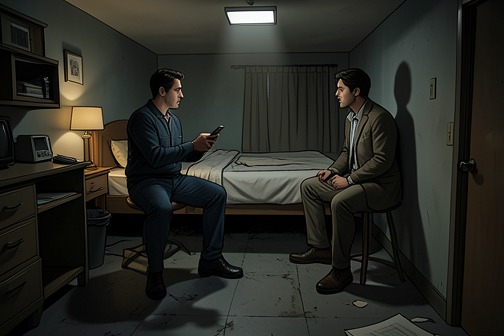
[Alex Delaware](entity:character-recall-character-alex-delaware-5f082af49613)’s confrontation with [Judy Manitow](entity:character-recall-character-judy-manitow-c4ec2e03b740) turns an ambiguous sighting at the motel into a reckoning over friendship, guilt, and the abuse of [Becky](entity:character-recall-character-becky-b2d09bb6c315) Manitow. By pressing Judy to explain why she accompanied [Joanne Doss](entity:character-recall-character-joanne-doss-c7eeadd2109e) at the end of her life, [Alex](entity:character-recall-character-alex-ad819204cb8d) forces into the open the family betrayal that had broken Judy and Joanne’s closeness—and makes clear that his own pursuit of the truth is entangled with a breach of professional confidentiality.
## The Motel Sighting and the Charge Against Judy
Alex tells Judy that someone saw her at the motel with Joanne. The witness did not know her identity, but the description was precise enough for Alex to connect it to Judy: a thin woman with short, conspicuously light, shiny hair, seen from behind as she got into a car. The sighting itself establishes neither why Judy was there nor what she did. Alex supplies the interpretation, insisting that [Eldon Mate](entity:character-recall-character-eldon-mate-fa61505a7baf) had nothing to do with this particular encounter: it had been Judy and Joanne together.
Judy initially treats Alex’s suggestion as nonsense. He offers what would be the charitable explanation: that she had gone to support a longtime friend who had decided to die and needed someone beside her. But their friendship had cooled, Alex argues, and the estrangement mattered. Joanne’s decision, in his reading, arose from crushing guilt over an act she could not forgive herself for; [Richard](entity:character-recall-character-richard-cc7ee1eeaeeb) had not forgiven her, and neither had Judy. Alex therefore suspects that Judy’s presence was not simply an act of mercy. He proposes that being there allowed Judy to witness Joanne’s end as a form of punishment, like a victim’s relatives watching an execution.
The accusation lands amid the formal tokens of Judy’s authority. As Alex presses the point, her hand finds a walnut gavel bearing a brass plaque, one among the tributes lining her paneled office. When he turns from Joanne’s death to the relationship between Joanne and Becky, Judy lunges forward and brings the gavel down. It slips from her grasp instead of striking its target; a paperweight skids off the desk and lands on the carpet with a weak sound. Judy’s control gives way in that small, ineffectual movement. Her eyes become wet, her mouth trembles, and she calls Alex a bastard and threatens to summon Leonard—but does not do so.
## The Confidentiality Barrier and Judy’s Account
After threatening to summon Leonard, Judy does not call him. Alex and Judy sit facing each other, and Alex questions whether his insistence on the truth serves anyone beyond his own obsession. Judy rises, crosses the room, and locks the door. Seated again, she looks down at the gavel before reminding Alex of his oath of confidentiality. He assures her he will not speak, but she repeats the warning: if she learns he has disclosed anything, even to his wife, she will see that he loses his license. Her decision to continue is therefore made under a strict condition of secrecy, not as a public accusation or a report to authorities.
Judy explains the betrayal through the labor and intimacy of raising a child. She recalls pregnancy, childbirth, sleepless nights, tending to a child’s needs, and guiding that child through tantrums, hurt feelings, and puberty. What makes the alleged abuse unbearable to her is that Joanne was someone she trusted, someone for whom she had done favors; Judy had entrusted Becky to her for tutoring because Becky was bright but struggled with mathematics. Judy describes finding Joanne and Becky together by the pool, while the math books lay wet on the deck and their swimsuits were wrinkled nearby. The ordinary arrangement of tutoring is recast as a breach of trust: the lesson that should have taken place has been displaced by the abuse Judy discovered.
Judy says Joanne and Becky both claimed it was the first time, but she did not believe them. In retrospect, Becky’s behavior had changed after she turned sixteen and began tutoring with Joanne: a girl who once talked to Judy stopped confiding in her, sometimes cried without an apparent reason, left the house without saying where she was going, and began receiving worse grades despite the tutoring. Judy suspects that the abuse may have continued for years, though she cannot establish its duration. Her account distinguishes what she saw at the pool from what she inferred from Becky’s earlier changes; the certainty of the violation is paired with uncertainty about how long it had gone on.
Judy says she did not question Becky after finding them together because Becky needed to heal, not be shamed. Her anger at Joanne is inseparable from that protective choice: the injury was not only a violation of the child but a betrayal of the trust that had made the tutoring possible. Judy’s disclosure also gives a sharper context to Alex’s earlier interpretation of her presence with Joanne at the motel. The friendship had been damaged by what Joanne did to Becky, and Judy’s account reveals why the possibility of accompanying Joanne at the end could carry both care and punishment.
## The Last Apology and Its Uneven Reach
The confrontation ends not with a fuller account of what Joanne told her family, but with Judy’s terse judgment that Joanne had finally done something right. Alex interprets the visit to the motel as Joanne’s last chance to apologize to Judy, a gesture whose meaning depends on the injury between them rather than on any reconciliation being achieved. Judy draws a finger across her lips and orders Alex to leave. Her final instruction returns the scene to silence: she has disclosed the harm Joanne caused Becky, but neither offers a complete history of it nor invites the disclosure to travel beyond the locked room.
The family members had not been given equal knowledge of Joanne’s decline or guilt. [Stacy](entity:character-recall-character-stacy-8e3c8bf1f57b), whom the family treated as the problem child, had been kept out of the loop; [Eric](entity:character-recall-character-eric-7ec3f96e28e6) had left school to care for his mother and may have learned more. Alex cannot say how much Joanne told him, only that he may have known she had done something Richard could not forgive without knowing the nature of the act. The uncertainty matters: the revelation about Becky clarifies the source of Joanne’s self-loathing, but the scene does not establish exactly what Eric understood or when he learned it.
Alex leaves with a final recognition of Judy’s divided loyalties. Although Joanne’s actions had harmed Judy’s family, Judy had still referred Stacy to Alex. That referral makes care persist across the breach without undoing it: Judy could protect Becky, condemn Joanne, and help Joanne’s daughter at once. The confrontation therefore closes on no easy absolution. Judy’s words acknowledge Joanne’s final act as an apology, while her dismissal preserves the boundary between acknowledging that gesture and forgiving the person who made it.
## What the Confrontation Establishes—and Leaves Unresolved
The scene separates a confirmed betrayal from an inferred motive. Judy’s account gives Alex a concrete reason for the collapse of her friendship with Joanne: the abuse of Becky and the trust Joanne had violated. It does not, however, make Judy explicitly confirm Alex’s theory that she went to the motel to witness Joanne’s death as punishment. Her final judgment that Joanne had at last done something right can be read as recognition of an attempted apology, but it does not settle whether Judy accepted it or why she stayed beside Joanne. The confrontation thus sharpens the moral history behind the motel sighting while preserving a gap between what Judy discloses about the past and what Alex believes her presence meant.